
Skip to content

Menu

  • Home
  • Herbs
    • A
      • Aconite (Bachnak)
      • Agarwood (Oud)
      • Alangium (Ankol)
      • Almond (Badam)
      • Aloe (Musabbar)
      • Alum (Phitkari)
      • Ammonium Chloride (Noshadar)
      • Aniseed (Anisoon)
      • Arjuna Tree (Arjun)
      • Ash Gourd (Petha)
      • Ashoka Tree (Asoka)
      • Ashwagandha (Asgand Nagori)
    • B
      • Bacopa (Jal Neem)
      • Bamboo (Baans)
      • Barley (Jau)
      • Behen Root (Behman Surkh o Safaid)
      • Belleric Myrobalan (Bahera)
      • Blepharis (Utangan)
      • Bristly Luffa (Bindal)
      • Bullet Wood (Maulsari)
    • C
      • Camel Thistle (Oont Katara)
      • Camel Thorn (Jawansa)
      • Cannabis (Bhang)
      • Carom Seeds (Ajwain)
      • Castor Plant (Arand)
      • Catmint (Billi Lotan)
      • Celery Seeds (Ajmod)
      • Chamomile (Babuna)
      • Citron (Bijora)
      • Clerodendrum (Arni)
      • Colocynth (Tumma / Indrayan)
      • Cotton Seed (Banola)
      • Country Mallow (Beej Band)
      • Croton Seeds (Jamal Gota)
    • D
      • Dodder (Aftimoon / Akas Bail)
    • E
      • Ebony (Aabnoos)
      • Eggplant (Baingan)
    • F
      • False Daisy (Bhangra)
      • Fig (Anjeer)
      • Flame of the Forest (Palas / Dhak)
      • Flaxseed (Alsi)
      • Fumitory (Papra / Shahtara)
    • G
      • Galbanum (Jawa Sheer)
      • Ginger (Adrak)
      • Ginger Benefits (Adrak)
      • Goosefoot (Bathua)
      • Gotu Kola (Brahmi)
      • Gum Ammoniacum (Ushaq)
    • H
      • Hemp (Bhang)
      • Henbane (Ajwain Khurasani)
      • Hibiscus (Gul-e-Gurhal)
      • Himalayan Birch (Bhojpatr)
      • Holy Basil (Tulsi)
      • Hygrophila Seeds (Talmakhana)
    • I
      • Indian Atis (Atees Talkh)
      • Indian Bay Leaf (Tez Pat)
      • Indian Birthwort (Ishar Mool)
      • Indian Gooseberry (Amla)
      • Indian Jujube (Ber)
      • Indian Kudzu (Badari Kand)
      • Indian Kudzu (Badari Kund)
      • Indian Persimmon (Tendu)
      • Indian Sarsaparilla (Anant Mool)
      • Indian Trumpet Tree (Arlu / Shivnak)
    • J
      • Jalap Root (Jalapa)
      • Java Plum (Jamun)
    • L
      • Larkspur (Jadwar)
      • Lavender (Ustukhudus)
      • Long Pepper (Pipli)
    • M
      • Mace (Javitri)
      • Maidenhair Fern (Parsiyaoshan)
      • Malabar Nut (Bansa / Vasaka)
      • Mango Ginger (Aamba Haldi)
      • Marking Nut (Bhilawa)
      • Mica (Abrak)
      • Mint (Pudina)
      • Miswak Tree (Peelu)
      • Mustard (Sarson)
    • N
      • Nalta Jute (Bahu Phali)
      • Nepeta
      • Nutmeg (Jaifal)
    • O
      • Okra (Bhindi)
      • Onion (Pyaaz)
      • Opium (Afeem)
      • Orris Root (Irsa)
    • P
      • Papaya (Papita)
      • Pearl Millet (Bajra)
      • Peppermint (Pudina)
      • Persian Lilac (Bakain)
      • Persian Manna (Taranjabin)
      • Pigeon Pea (Arhar)
      • Pistachio (Pista)
      • Pointed Gourd (Patol)
      • Polypodium
      • Polypody (Besfaij)
      • Poppy Husk (Poost Koknaar)
      • Portia Tree (Paras Peepal)
      • Prickly Chaff Flower (Puthkanda)
      • Prunes (Alu Bukhara)
      • Psoralea Seeds (Babchi)
      • Psyllium Husk (Ispaghol)
      • Punarnava (Bishkhapra)
      • Purging Cassia (Amaltas)
      • Putranjiva (Jiya Pota)
    • Q
      • Quince (Bahi)
      • Quince Seeds (Behidana)
    • R
      • Ribwort Plantain (Bartang Sabz)
      • Ridge Gourd (Tori)
      • Rocket Seeds (Taramira)
      • Rockfoil (Pathri Tor)
      • Round Gourd (Tinda)
    • S
      • Sacred Fig (Peepal)
      • Saffron (Kesar)
      • Salep Orchid (Salep Misri)
      • Sappan Wood (Patang / Baqam)
      • Sesame Seeds (Til)
      • Sickle Senna (Panwar)
      • Silver Fir Leaf (Talispatar)
      • Snap Melon (Phoot)
      • Sorghum (Jowar)
      • Spinach (Palak)
      • Sweet Violet (Banafsha)
      • Syrian Rue (Harmal / Espand)
    • T
      • Tamarind (Imli)
      • Tamarisk (Jhao)
      • Taro (Arvi)
      • Tellicherry Bark (Indarjo Talkh)
      • Three-leaved Caper (Barna)
      • Tobacco (Tambaku)
      • Tomato (Tamatar)
      • Trumpet Flower Tree (Padhal)
    • U
      • Uraria Picta (Prishniparni)
    • V
      • Valerian
      • Valerian (Balchhar)
    • W
      • Wallflower (Todri)
      • Walnut (Akhrot)
      • Water Coriander (Jal Dhaniya)
      • Water Lettuce (Jal Khumbi)
      • White Goosefoot (Bathua)
      • Wild Himalayan Cherry (Padmakh)
      • Willow Flower (Bed Mushk)
    • Y
      • Yarrow (Burnajasuf)
  • Introduction
  • History
  • Ajmal Khan Portfolio
  • Resources
  • Contact

Archives

  • November 2026
  • May 2025
  • July 2023

Calendar

November 2026
M T W T F S S
 1
2345678
9101112131415
16171819202122
23242526272829
30  
« May    

Categories

  • A
  • B
  • C
  • D
  • E
  • F
  • G
  • H
  • Herbs
  • I
  • J
  • L
  • M
  • N
  • O
  • P
  • Q
  • R
  • S
  • T
  • U
  • V
  • W
  • Y

Copyright Unani Medicine 2026 | Theme by ThemeinProgress | Proudly powered by WordPress

Lastest Blog
  • Blepharis (Utangan)
  • Lavender (Ustukhudus)
  • Gum Ammoniacum (Ushaq)
  • Colocynth (Tumma / Indrayan)
  • Holy Basil (Tulsi)
Unani Medicine
  • Home
  • Herbs
    • A
      • Aconite (Bachnak)
      • Agarwood (Oud)
      • Alangium (Ankol)
      • Almond (Badam)
      • Aloe (Musabbar)
      • Alum (Phitkari)
      • Ammonium Chloride (Noshadar)
      • Aniseed (Anisoon)
      • Arjuna Tree (Arjun)
      • Ash Gourd (Petha)
      • Ashoka Tree (Asoka)
      • Ashwagandha (Asgand Nagori)
    • B
      • Bacopa (Jal Neem)
      • Bamboo (Baans)
      • Barley (Jau)
      • Behen Root (Behman Surkh o Safaid)
      • Belleric Myrobalan (Bahera)
      • Blepharis (Utangan)
      • Bristly Luffa (Bindal)
      • Bullet Wood (Maulsari)
    • C
      • Camel Thistle (Oont Katara)
      • Camel Thorn (Jawansa)
      • Cannabis (Bhang)
      • Carom Seeds (Ajwain)
      • Castor Plant (Arand)
      • Catmint (Billi Lotan)
      • Celery Seeds (Ajmod)
      • Chamomile (Babuna)
      • Citron (Bijora)
      • Clerodendrum (Arni)
      • Colocynth (Tumma / Indrayan)
      • Cotton Seed (Banola)
      • Country Mallow (Beej Band)
      • Croton Seeds (Jamal Gota)
    • D
      • Dodder (Aftimoon / Akas Bail)
    • E
      • Ebony (Aabnoos)
      • Eggplant (Baingan)
    • F
      • False Daisy (Bhangra)
      • Fig (Anjeer)
      • Flame of the Forest (Palas / Dhak)
      • Flaxseed (Alsi)
      • Fumitory (Papra / Shahtara)
    • G
      • Galbanum (Jawa Sheer)
      • Ginger (Adrak)
      • Ginger Benefits (Adrak)
      • Goosefoot (Bathua)
      • Gotu Kola (Brahmi)
      • Gum Ammoniacum (Ushaq)
    • H
      • Hemp (Bhang)
      • Henbane (Ajwain Khurasani)
      • Hibiscus (Gul-e-Gurhal)
      • Himalayan Birch (Bhojpatr)
      • Holy Basil (Tulsi)
      • Hygrophila Seeds (Talmakhana)
    • I
      • Indian Atis (Atees Talkh)
      • Indian Bay Leaf (Tez Pat)
      • Indian Birthwort (Ishar Mool)
      • Indian Gooseberry (Amla)
      • Indian Jujube (Ber)
      • Indian Kudzu (Badari Kand)
      • Indian Kudzu (Badari Kund)
      • Indian Persimmon (Tendu)
      • Indian Sarsaparilla (Anant Mool)
      • Indian Trumpet Tree (Arlu / Shivnak)
    • J
      • Jalap Root (Jalapa)
      • Java Plum (Jamun)
    • L
      • Larkspur (Jadwar)
      • Lavender (Ustukhudus)
      • Long Pepper (Pipli)
    • M
      • Mace (Javitri)
      • Maidenhair Fern (Parsiyaoshan)
      • Malabar Nut (Bansa / Vasaka)
      • Mango Ginger (Aamba Haldi)
      • Marking Nut (Bhilawa)
      • Mica (Abrak)
      • Mint (Pudina)
      • Miswak Tree (Peelu)
      • Mustard (Sarson)
    • N
      • Nalta Jute (Bahu Phali)
      • Nepeta
      • Nutmeg (Jaifal)
    • O
      • Okra (Bhindi)
      • Onion (Pyaaz)
      • Opium (Afeem)
      • Orris Root (Irsa)
    • P
      • Papaya (Papita)
      • Pearl Millet (Bajra)
      • Peppermint (Pudina)
      • Persian Lilac (Bakain)
      • Persian Manna (Taranjabin)
      • Pigeon Pea (Arhar)
      • Pistachio (Pista)
      • Pointed Gourd (Patol)
      • Polypodium
      • Polypody (Besfaij)
      • Poppy Husk (Poost Koknaar)
      • Portia Tree (Paras Peepal)
      • Prickly Chaff Flower (Puthkanda)
      • Prunes (Alu Bukhara)
      • Psoralea Seeds (Babchi)
      • Psyllium Husk (Ispaghol)
      • Punarnava (Bishkhapra)
      • Purging Cassia (Amaltas)
      • Putranjiva (Jiya Pota)
    • Q
      • Quince (Bahi)
      • Quince Seeds (Behidana)
    • R
      • Ribwort Plantain (Bartang Sabz)
      • Ridge Gourd (Tori)
      • Rocket Seeds (Taramira)
      • Rockfoil (Pathri Tor)
      • Round Gourd (Tinda)
    • S
      • Sacred Fig (Peepal)
      • Saffron (Kesar)
      • Salep Orchid (Salep Misri)
      • Sappan Wood (Patang / Baqam)
      • Sesame Seeds (Til)
      • Sickle Senna (Panwar)
      • Silver Fir Leaf (Talispatar)
      • Snap Melon (Phoot)
      • Sorghum (Jowar)
      • Spinach (Palak)
      • Sweet Violet (Banafsha)
      • Syrian Rue (Harmal / Espand)
    • T
      • Tamarind (Imli)
      • Tamarisk (Jhao)
      • Taro (Arvi)
      • Tellicherry Bark (Indarjo Talkh)
      • Three-leaved Caper (Barna)
      • Tobacco (Tambaku)
      • Tomato (Tamatar)
      • Trumpet Flower Tree (Padhal)
    • U
      • Uraria Picta (Prishniparni)
    • V
      • Valerian
      • Valerian (Balchhar)
    • W
      • Wallflower (Todri)
      • Walnut (Akhrot)
      • Water Coriander (Jal Dhaniya)
      • Water Lettuce (Jal Khumbi)
      • White Goosefoot (Bathua)
      • Wild Himalayan Cherry (Padmakh)
      • Willow Flower (Bed Mushk)
    • Y
      • Yarrow (Burnajasuf)
  • Introduction
  • History
  • Ajmal Khan Portfolio
  • Resources
  • Contact
Adrak (Ginger) – Unani herb
Written by adminNovember 25, 2026

Ginger (Adrak)

G . Herbs Article

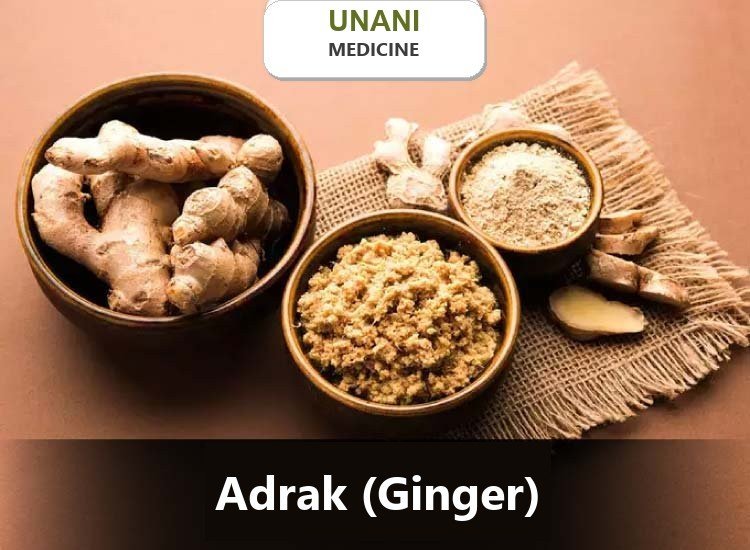
Adrak (Zingiber officinale) (fresh ginger) and sonth (dry ginger) are hot, pungent roots used in Unani medicine for digestion, gas, colic, phlegmatic cough, hiccups and sciatica.

Botanical name: Zingiber officinale

Other Names

Known as Adrak; in Hindi Adrak; in Sanskrit Adrakam; in Bengali Sonth, Aada; in Marathi Alem; in Gujarati Aadu; in Kannada Aal Sonthi; in Arabic Zanjabeel Ratb (fresh) and Zanjabeel Yabis (dry); in English Ginger; in Latin Zingiber. (Another source: Zanjabeel in Arabic, Adu in Gujarati, Aadu or Aada in Bengali, Sandh in Sindhi, Sharnjeer in Persian; Adrak and Sonth in Hindi, Punjabi, Urdu and Kashmiri.) Latin: Zingiber officinale.

Identification

Ginger is cultivated abundantly in India. It is sown in spring and matures at the beginning of winter. The plant grows two to three feet high. It is the root of the plant. The leaves are green, long and thin. When the flowers fall and the stem dries, it is dug up. The color is brownish-white, the smell strong, and the taste so sharp that it seems to enter the tongue. It should always be peeled before use. It is harmful for people of hot temperament and for constipation. Fresh ginger is hot in the third degree and dry in the first; dried ginger is dry in the second degree. Its harm is removed by almond oil and honey. Suitable substitutes are long pepper (pipli), pellitory (aaqarqarha) and black pepper. The dose is five to ten ratti.

In more detail: the plant grows three to four feet high. The leaves are nine to ten inches long, one inch wide and pointed at the tip. The flower stalk is two to three inches long. The flowers are very few and fine, violet or purple. It bears no fruit, and ginger is propagated from its own pieces: small pieces of ginger are cut like potatoes and buried in the ground. With manure, water and sun they slowly grow into ginger. It is sown in the months of Chait and Baisakh and dug up in Asuj and Katik (September and October).

There are two kinds of ginger: one fibrous, which is produced in great quantity, and another without fibers, which is produced less. When dried, it becomes sonth or zanjabeel (dry ginger).

Habitat

It is found, more or less, throughout the subcontinent: in Pakistan in Punjab and Jammu and Kashmir; in India in Punjab and the hill areas of U.P.; and also in Madras, Cochin, Bihar, Bombay, Surat, Ahmedabad and Bangladesh.

Color and Taste

Fresh ginger is white and brown, while dry ginger (zanjabeel) is yellow. The taste is sharp, pungent and bitter. It has been used as medicine and as food since ancient times.

Method of Drying

Ginger that has been left buried in the ground a long time and has fully ripened is peeled on the outside and dried in the shade. It becomes sonth (dry ginger). Dry ginger quickly gets infested with weevils.

Temperament (Mizaj)

Fresh ginger is hot in the third degree and dry in the first degree. Dry ginger (zanjabeel) is hot in the third degree and dry in the second degree; the older it is, the drier it becomes.

Actions

Aphrodisiac tonic (muqawwi-e-bah), tonic for the mind and memory, digestive (hazim), wind-breaking (kasir-e-riyah), killer of intestinal worms, laxative (mulayyin), and expectorant of viscous phlegm.

Dosage

One masha to one and a half or two masha. (Hakim Ram Labhaya, in his book Bayan-ul-Adviya, counts ginger as part of Trikatu: sonth, black pepper and long pepper.)

Benefits

It is a tonic for the brain, digestion, stomach and liver, and benefits bloating, gas and weakness. It removes phlegm and clears the system. If it is boiled too long in water, its useful constituents are lost. In phlegmatic cough, one spoon of ginger juice with honey is useful. Using ginger with the yolk of a boiled egg increases semen and thickens it. Ginger juice is useful for pterygium of the eye (nakhuna). For prolapse of the intestine (hernia), ginger preserve (murabba) is very useful. For paralysis (hemiplegia), using ginger preserve and keeping nutmeg in the mouth at all times is very useful.

Dry ginger is an extremely useful medicine for people of phlegmatic temperament. It is used in most stomach diseases such as bloating, abdominal pain and loss of appetite. It is a corrective of drugs that cause gripping, such as senna Makki and white turbith. Ginger preserve cleanses the stomach (acts as a laxative). If diarrhea is caused by moistures in the intestines and stomach, it produces constipation and stops the diarrhea. It is used in aphrodisiac tonic electuaries.

Externally, burning it in oil or making an oil with other medicines and massaging with it is useful in windy pains such as gout, paralysis and backache. Ground as a kohl and applied to the eyes, it is useful for clearing eye haze. It is useful to give in asthma and cough. It kills intestinal worms. Majun Zanjabeel is an elixir for soft (flabby) conditions, leucorrhea (sailan-ur-rahm), weak stomach, forgetfulness, back pain and sexual weakness.

In the disease sangrahani (chronic diarrhea), it is useful to fry dry ginger in ghee (until it reddens but does not burn) and give it with buttermilk two to three times a day.

Mixing ten grams of fried ginger with three grams of table salt and rubbing it on the teeth removes sourness of the teeth.

The Qur’an mentions ginger (translation): "And they will be given to drink a cup whose mixture is of ginger."

Sayings of the Prophet (peace be upon him): Abu Sa’id al-Khudri (may Allah be pleased with him) reports: "The emperor of Rome presented to the Messenger of Allah (peace be upon him) a jar of ginger preserve as a gift. After accepting it, he gave everyone a piece of it, and I too received a piece, which I ate."

Special Benefit

Dissolves gas (muhallil-e-riyah) and aids digestion of food.

Side Effects

For diseases of the throat caused by heat.

Corrective (Muslih)

Almond oil and pure honey.

Substitute (Badal)

Dar felfel (long pepper root).

Home Remedies and Formulas

Murabba Adrak (Ginger Preserve)

Clean fresh, thick, fiber-free ginger of its peel and boil it in water. Then add a little salt and boil thoroughly. When it becomes soft, take it out and add it to a syrup of white sugar. On the second day, if the syrup has become thin, cook it again together with the ginger until it is right.

Benefits: Eat one to two tola. It is useful for expelling phlegm, gas, stomach pain and backache, and for strengthening the kidneys.

Colic Pain

Put two and a half tola of half-crushed dry ginger into fifteen tola of boiling water and let it stand for an hour. Then strain the water and add 9 masha of baking soda (sodium bicarbonate).

Benefits: Give three to five tola as needed, two to three times a day. It is useful in indigestion, nausea and vomiting, and removes bloating of the stomach and windy colic.

Remedy for Hiccups

Boil five masha of dry ginger and five grains of black pepper in water and give twice a day. It is useful for hiccups.

Remedy for Sangrahani

Dry ginger five tola, fennel five tola, myrobalan (harad) five tola, sugar fifteen tola; grind each separately and mix. Dose: one to three masha twice a day. It is useful for dysentery, sangrahani, weak stomach and diarrhea from indigestion.

Stomach Pain

Take dry ginger and ajwain as needed, add enough lemon juice to wet them, then dry in the shade and grind finely. Mix in a little black salt and store. Dose: four to six ratti with water; all stomach disorders are removed. It corrects digestion and is useful for stomach pain and foul belching.

Kushta of Silver with Ginger Juice

Grind one tola of silver leaf (varaq) in fifteen tola of ginger juice until it can be formed into small cakes. Then seal the cakes in clay-smeared pots (gil-e-hikmat) and, when dry, give them the fire of twenty ser of cow-dung cakes; do this three times. It will become fine. Give 2 to 3 rice-grain weights with khamira, majun or butter. It is a tonic of the vital spirits (muqawwi-e-arwah), a tonic and removes spermatorrhea.

Chemical Analysis

Per hundred grams of dry ginger (sonth): fat 3.3, starch 20.7, fibrous constituents 7.4, moisture, sodium 5, potassium 943, calories 333, magnesium 256, phosphorus 177, sulfur 1280, chloride 62 (as given in the source).

Ginger contains 12 to 15 percent water-soluble salts, and a volatile oil (Oil of Ginger) between one and four percent, of the terpene family of elements, in addition to gingerol, the essence of the pungency of ginger’s aroma, which belongs to the carbolic acid family as a fatty resin.

Modern observations and constituents show that the benefits described for garlic that could not be obtained from garlic are the same ones obtained from dry ginger.

Famous Compounds

Jawarish Zanjabeel, Majun Zanjabeel, Jawarish Jalinus, Jawarish Bisbasa, Majun Nankhwah (Hamdard), Safoof Nankhwah, Jauhar-e-Hazim (Tibb-e-Nabawi Dawakhana).

Tried Prescription for Sciatica (Irq-un-Nasa)

Make a powder of the best quality ginger and mix it with pure honey; take it morning and evening before meals with water, one small spoon at a time, or just as it is. (Tried by Hakim Naseer Ahmad Tariq)

Sources

Encyclopedia of Herbs by Hakim and Dr. Hari Chand Multani; Taj-ul-Mufradat (Research on Khawas-ul-Adwiya) by Dr. and Hakim Naseer Ahmad Tariq.

More Unani herbs

  • Ginger Benefits (Adrak)
  • Goosefoot (Bathua)
  • Gotu Kola (Brahmi)
  • Gum Ammoniacum (Ushaq)
  • Galbanum (Jawa Sheer)

Browse all herbs starting with G or the complete A–Z list of Unani herbs.

This information comes from classical Unani texts and is for education only. Please consult a qualified hakim or doctor before using any herb, especially during pregnancy or alongside other medicines.

You may also like

Blepharis (Utangan)

Lavender (Ustukhudus)

Gum Ammoniacum (Ushaq)

Leave a Reply Cancel reply

Your email address will not be published. Required fields are marked *

Archives

  • November 2026
  • May 2025
  • July 2023

Calendar

November 2026
M T W T F S S
 1
2345678
9101112131415
16171819202122
23242526272829
30  
« May    

Categories

  • A
  • B
  • C
  • D
  • E
  • F
  • G
  • H
  • Herbs
  • I
  • J
  • L
  • M
  • N
  • O
  • P
  • Q
  • R
  • S
  • T
  • U
  • V
  • W
  • Y

Copyright Unani Medicine 2026 | Theme by ThemeinProgress | Proudly powered by WordPress