
Skip to content

Menu

  • Home
  • Herbs
    • A
      • Aconite (Bachnak)
      • Acorn (Balut)
      • Agaric (Ghariqoon)
      • Agarwood (Oud)
      • Alangium (Ankol)
      • Alkanet (Ratanjot)
      • Almond (Badam)
      • Aloe (Musabbar)
      • Alum (Phitkari)
      • Amber (Kahruba)
      • Ammonium Chloride (Noshadar)
      • Aniseed (Anisoon)
      • Apple (Seb)
      • Apricot (Khubani)
      • Arjuna Tree (Arjun)
      • Asafoetida (Heeng)
      • Asarabacca (Asaroon)
      • Ash Gourd (Petha)
      • Ashoka Tree (Asoka)
      • Ashwagandha (Asgand Nagori)
      • Asparagus (Halyun)
      • Asthma Weed (Dudhi)
    • B
      • Babul Acacia (Babool)
      • Bacopa (Jal Neem)
      • Bael Fruit (Bael)
      • Balangu Seed (Tukhm-e-Balanga)
      • Balsam Fruit (Habb-ul-Balsan)
      • Bamboo (Baans)
      • Banana (Kela)
      • Banyan (Bargad)
      • Barberry Fruit (Zarishk)
      • Barley (Jau)
      • Bay Laurel (Habb-ul-Ghar)
      • Bdellium (Muql)
      • Beard Lichen (Usna)
      • Beetroot (Chukandar)
      • Behen Root (Behman Surkh o Safaid)
      • Belleric Myrobalan (Bahera)
      • Betel Leaf (Tambool)
      • Bitter Colchicum (Suranjan Talkh)
      • Bitter Gourd (Karela)
      • Black Cardamom (Ilaichi Kalan)
      • Black Cumin (Zeera Siyah)
      • Black Gram (Mash)
      • Black Mulberry (Toot Siyah)
      • Black Musli (Moosli Siyah)
      • Black Myrobalan (Haleela Siyah)
      • Black Nightshade (Mako)
      • Black Pepper (Filfil Siyah)
      • Black Seed (Kalonji)
      • Blepharis (Utangan)
      • Borage (Gaozaban)
      • Bottle Gourd (Lauki)
      • Bristly Luffa (Bindal)
      • Brown Mustard (Rai)
      • Bullet Wood (Maulsari)
    • C
      • Camel Thistle (Oont Katara)
      • Camel Thorn (Jawansa)
      • Camphor (Kafoor)
      • Cannabis (Bhang)
      • Caper (Kabar)
      • Carom Seeds (Ajwain)
      • Castor Plant (Arand)
      • Catechu (Kattha)
      • Catmint (Billi Lotan)
      • Celery Seeds (Ajmod)
      • Centaury (Qantoriyun)
      • Ceylon Ironwood (Nagkesar)
      • Ceylon Leadwort (Chitrak)
      • Chamomile (Babuna)
      • Chaste Tree (Panjangusht)
      • Chickpea (Chana)
      • Chicory Root (Bekh-e-Kasni)
      • China Root (Chob Chini)
      • Chiretta (Chiraita)
      • Cinnamon (Dalchini)
      • Citron (Bijora)
      • Clearing Nut (Nirmali)
      • Clerodendrum (Arni)
      • Clove (Laung)
      • Cluster Fig (Gular)
      • Coconut (Nariyal)
      • Coffee Senna (Kasondi)
      • Colocynth (Tumma / Indrayan)
      • Common Mallow (Gul-e-Khairu)
      • Coriander (Dhaniya)
      • Costus (Kuth)
      • Cotton Seed (Banola)
      • Country Mallow (Beej Band)
      • Crab’s Claw Gall (Kakra Singhi)
      • Croton Seeds (Jamal Gota)
      • Crown Flower (Aakh)
      • Cubeb (Kababchini)
      • Cucumber (Khiyar)
      • Cuddapah Almond (Chiraunji)
      • Cumin (Zeera Safaid)
      • Curry Leaf (Kari Patta)
      • Cypress (Sarw)
      • Cypriol (Saad Kufi)
    • D
      • Damask Rose (Gul-e-Surkh)
      • Date Palm (Khurma)
      • Dill (Soya)
      • Dodder (Aftimoon / Akas Bail)
      • Dragon’s Blood (Dammul Akhwain)
      • Drumstick Tree (Sahjan)
    • E
      • East Indian Globe Thistle (Gul-e-Mundi)
      • Ebony (Aabnoos)
      • Eggplant (Baingan)
      • Elephant Foot Yam (Zamikand)
    • F
      • False Daisy (Bhangra)
      • Felty Germander (Jaada)
      • Fennel (Saunf)
      • Fenugreek (Hulba)
      • Fever Nut (Karanjwa)
      • Fig (Anjeer)
      • Fire Flame Bush (Gul-e-Dhawa)
      • Five-leaved Chaste Tree (Sanbhalu)
      • Flame of the Forest (Palas / Dhak)
      • Flaxseed (Alsi)
      • Flixweed (Khaksi)
      • Fox Nut (Makhana)
      • Frankincense (Kundur)
      • Fumitory (Papra / Shahtara)
    • G
      • Galbanum (Jawa Sheer)
      • Garden Cress Seed (Tukhm-e-Haleem)
      • Garlic (Lahsun)
      • Giloy (Gilo)
      • Ginger (Adrak)
      • Ginger Benefits (Adrak)
      • Goldthread (Mamiran)
      • Goosefoot (Bathua)
      • Gotu Kola (Brahmi)
      • Greater Galangal (Khulanjan)
      • Green Cardamom (Ilaichi Khurd)
      • Green Chiretta (Kalmegh)
      • Guava (Amrood)
      • Gum Ammoniacum (Ushaq)
      • Gum Arabic (Samagh Arabi)
      • Gurmar (Gurmar Booti)
    • H
      • Hazelnut (Fundaq)
      • Hemp (Bhang)
      • Henbane (Ajwain Khurasani)
      • Henna (Barg-e-Hina)
      • Hibiscus (Gul-e-Gurhal)
      • Himalayan Birch (Bhojpatr)
      • Himalayan Cedar (Deodar)
      • Holy Basil (Tulsi)
      • Horse Gram (Kulthi)
      • Hygrophila Seeds (Talmakhana)
      • Hyssop (Zoofa)
    • I
      • Indian Atis (Atees Talkh)
      • Indian Barberry (Darhald)
      • Indian Bay Leaf (Tez Pat)
      • Indian Beech (Karanj)
      • Indian Birthwort (Ishar Mool)
      • Indian Camphorweed (Rasna)
      • Indian Cherry (Lasora)
      • Indian Gooseberry (Amla)
      • Indian Jujube (Ber)
      • Indian Kino Tree (Bijasar)
      • Indian Kudzu (Badari Kand)
      • Indian Kudzu (Badari Kund)
      • Indian Madder (Majith)
      • Indian Persimmon (Tendu)
      • Indian Sarsaparilla (Anant Mool)
      • Indian Trumpet Tree (Arlu / Shivnak)
      • Indian Valerian (Tagar)
    • J
      • Jalap Root (Jalapa)
      • Java Plum (Jamun)
      • Juniper (Abhal)
    • K
      • Kamala (Kamila)
    • L
      • Large Caltrops (Ghokhru Kalan)
      • Larkspur (Jadwar)
      • Lavender (Ustukhudus)
      • Leek (Kurrath)
      • Lemon (Limu)
      • Lemon Grass (Izkhir)
      • Lentil (Masoor)
      • Leopard’s Bane (Darunaj Aqrabi)
      • Lettuce (Kahu)
      • Liquorice (Asl-us-Soos)
      • Lodh Tree (Lodh Pathani)
      • Long Birthwort (Zarawand Taweel)
      • Long Pepper (Pipli)
      • Lotus Seed (Tukhm-e-Kanwal)
    • M
      • Mace (Javitri)
      • Mahaleb Cherry (Habb-ul-Mahlab)
      • Maidenhair Fern (Parsiyaoshan)
      • Malabar Nut (Bansa / Vasaka)
      • Mallow (Khubbazi)
      • Mandrake Root (Yabruj)
      • Mango (Aam)
      • Mango Ginger (Aamba Haldi)
      • Manna (Shirkhisht)
      • Marking Nut (Bhilawa)
      • Mastic (Mastagi)
      • Melon Seed (Tukhm-e-Kharbuza)
      • Mexican Prickly Poppy (Satyanashi)
      • Mica (Abrak)
      • Mint (Pudina)
      • Miswak Tree (Peelu)
      • Morning Glory Seed (Habb-ul-Neel)
      • Mountain Ebony (Kachnar)
      • Mulberry (Shehtoot)
      • Mung Bean (Moong)
      • Musk Mallow (Mushkdana)
      • Mustard (Sarson)
      • Myrrh (Mur Makki)
      • Myrtle (Habb-ul-Aas)
    • N
      • Nalta Jute (Bahu Phali)
      • Nepeta
      • Night Jasmine (Harsingar)
      • Nut Grass (Nagarmotha)
      • Nutmeg (Jaifal)
      • Nux Vomica (Kuchla)
    • O
      • Oak Gall (Majuphal)
      • Okra (Bhindi)
      • Oleander (Kaner)
      • Olive (Jaitun)
      • Onion (Pyaaz)
      • Opium (Afeem)
      • Orris Root (Irsa)
    • P
      • Papaya (Papita)
      • Pearl Millet (Bajra)
      • Pellitory (Akarkara)
      • Pennyroyal (Fodanj)
      • Peony Root (Ood-e-Saleeb)
      • Peppermint (Pudina)
      • Persian Lilac (Bakain)
      • Persian Manna (Taranjabin)
      • Phalsa (Falsa)
      • Picrorhiza (Kutki)
      • Pigeon Pea (Arhar)
      • Pine Nut (Chilgoza)
      • Pistachio (Pista)
      • Pointed Gourd (Patol)
      • Polypodium
      • Polypody (Besfaij)
      • Pomegranate (Anar)
      • Poppy Husk (Poost Koknaar)
      • Portia Tree (Paras Peepal)
      • Prickly Chaff Flower (Puthkanda)
      • Prunes (Alu Bukhara)
      • Psoralea Seeds (Babchi)
      • Psyllium Husk (Ispaghol)
      • Pumpkin (Kaddu)
      • Punarnava (Bishkhapra)
      • Purging Cassia (Amaltas)
      • Purple Fleabane (Kalijeeri)
      • Purslane (Khurfa)
      • Putranjiva (Jiya Pota)
    • Q
      • Quince (Bahi)
      • Quince Seeds (Behidana)
    • R
      • Radish (Mooli)
      • Raisin (Kishmish)
      • Red Sandalwood (Sandal Surkh)
      • Rhubarb (Revand Chini)
      • Ribwort Plantain (Bartang Sabz)
      • Ridge Gourd (Tori)
      • Rocket Seeds (Taramira)
      • Rockfoil (Pathri Tor)
      • Round Gourd (Tinda)
      • Rue (Sudab)
    • S
      • Sacred Fig (Peepal)
      • Safflower (Qurtum)
      • Saffron (Kesar)
      • Sagapenum (Sakbeenaj)
      • Sal Resin (Raal)
      • Salep Orchid (Salep Misri)
      • Sappan Wood (Patang / Baqam)
      • Sarcocolla (Anzaroot)
      • Sarsaparilla (Usaba)
      • Scammony (Sakmunia)
      • Screwpine (Kewra)
      • Sebesten Plum (Sapistan)
      • Senna (Sana Makki)
      • Sesame Seeds (Til)
      • Sickle Senna (Panwar)
      • Silver Fir Leaf (Talispatar)
      • Small Caltrops (Gokhru Khurd)
      • Snap Melon (Phoot)
      • Sorghum (Jowar)
      • Spinach (Palak)
      • Stone Flower Lichen (Gul-e-Ashna)
      • Sweet Basil (Faranjmushk)
      • Sweet Violet (Banafsha)
      • Syrian Rue (Harmal / Espand)
    • T
      • Tamarind (Imli)
      • Tamarisk (Jhao)
      • Taro (Arvi)
      • Tellicherry Bark (Indarjo Talkh)
      • Three-leaved Caper (Barna)
      • Tobacco (Tambaku)
      • Tomato (Tamatar)
      • Tropical Sickle Pod (Chaksu)
      • Trumpet Flower Tree (Padhal)
    • U
      • Uraria Picta (Prishniparni)
    • V
      • Valerian
      • Valerian (Balchhar)
    • W
      • Wallflower (Todri)
      • Walnut (Akhrot)
      • Water Coriander (Jal Dhaniya)
      • Water Lettuce (Jal Khumbi)
      • White Goosefoot (Bathua)
      • Wild Himalayan Cherry (Padmakh)
      • Willow Flower (Bed Mushk)
    • Y
      • Yarrow (Burnajasuf)
  • Introduction
  • History
  • Ajmal Khan Portfolio
  • Resources
  • Contact

Categories

  • A
  • B
  • C
  • D
  • E
  • F
  • G
  • H
  • Herbs
  • I
  • J
  • K
  • L
  • M
  • N
  • O
  • P
  • Q
  • R
  • S
  • T
  • U
  • V
  • W
  • Y

Copyright Unani Medicine 2026 | Theme by ThemeinProgress | Proudly powered by WordPress

Lastest Blog
  • Senna (Sana Makki)
  • Sebesten Plum (Sapistan)
  • Scammony (Sakmunia)
  • Sarsaparilla (Usaba)
  • Sarcocolla (Anzaroot)
Unani Medicine
  • Home
  • Herbs
    • A
      • Aconite (Bachnak)
      • Acorn (Balut)
      • Agaric (Ghariqoon)
      • Agarwood (Oud)
      • Alangium (Ankol)
      • Alkanet (Ratanjot)
      • Almond (Badam)
      • Aloe (Musabbar)
      • Alum (Phitkari)
      • Amber (Kahruba)
      • Ammonium Chloride (Noshadar)
      • Aniseed (Anisoon)
      • Apple (Seb)
      • Apricot (Khubani)
      • Arjuna Tree (Arjun)
      • Asafoetida (Heeng)
      • Asarabacca (Asaroon)
      • Ash Gourd (Petha)
      • Ashoka Tree (Asoka)
      • Ashwagandha (Asgand Nagori)
      • Asparagus (Halyun)
      • Asthma Weed (Dudhi)
    • B
      • Babul Acacia (Babool)
      • Bacopa (Jal Neem)
      • Bael Fruit (Bael)
      • Balangu Seed (Tukhm-e-Balanga)
      • Balsam Fruit (Habb-ul-Balsan)
      • Bamboo (Baans)
      • Banana (Kela)
      • Banyan (Bargad)
      • Barberry Fruit (Zarishk)
      • Barley (Jau)
      • Bay Laurel (Habb-ul-Ghar)
      • Bdellium (Muql)
      • Beard Lichen (Usna)
      • Beetroot (Chukandar)
      • Behen Root (Behman Surkh o Safaid)
      • Belleric Myrobalan (Bahera)
      • Betel Leaf (Tambool)
      • Bitter Colchicum (Suranjan Talkh)
      • Bitter Gourd (Karela)
      • Black Cardamom (Ilaichi Kalan)
      • Black Cumin (Zeera Siyah)
      • Black Gram (Mash)
      • Black Mulberry (Toot Siyah)
      • Black Musli (Moosli Siyah)
      • Black Myrobalan (Haleela Siyah)
      • Black Nightshade (Mako)
      • Black Pepper (Filfil Siyah)
      • Black Seed (Kalonji)
      • Blepharis (Utangan)
      • Borage (Gaozaban)
      • Bottle Gourd (Lauki)
      • Bristly Luffa (Bindal)
      • Brown Mustard (Rai)
      • Bullet Wood (Maulsari)
    • C
      • Camel Thistle (Oont Katara)
      • Camel Thorn (Jawansa)
      • Camphor (Kafoor)
      • Cannabis (Bhang)
      • Caper (Kabar)
      • Carom Seeds (Ajwain)
      • Castor Plant (Arand)
      • Catechu (Kattha)
      • Catmint (Billi Lotan)
      • Celery Seeds (Ajmod)
      • Centaury (Qantoriyun)
      • Ceylon Ironwood (Nagkesar)
      • Ceylon Leadwort (Chitrak)
      • Chamomile (Babuna)
      • Chaste Tree (Panjangusht)
      • Chickpea (Chana)
      • Chicory Root (Bekh-e-Kasni)
      • China Root (Chob Chini)
      • Chiretta (Chiraita)
      • Cinnamon (Dalchini)
      • Citron (Bijora)
      • Clearing Nut (Nirmali)
      • Clerodendrum (Arni)
      • Clove (Laung)
      • Cluster Fig (Gular)
      • Coconut (Nariyal)
      • Coffee Senna (Kasondi)
      • Colocynth (Tumma / Indrayan)
      • Common Mallow (Gul-e-Khairu)
      • Coriander (Dhaniya)
      • Costus (Kuth)
      • Cotton Seed (Banola)
      • Country Mallow (Beej Band)
      • Crab’s Claw Gall (Kakra Singhi)
      • Croton Seeds (Jamal Gota)
      • Crown Flower (Aakh)
      • Cubeb (Kababchini)
      • Cucumber (Khiyar)
      • Cuddapah Almond (Chiraunji)
      • Cumin (Zeera Safaid)
      • Curry Leaf (Kari Patta)
      • Cypress (Sarw)
      • Cypriol (Saad Kufi)
    • D
      • Damask Rose (Gul-e-Surkh)
      • Date Palm (Khurma)
      • Dill (Soya)
      • Dodder (Aftimoon / Akas Bail)
      • Dragon’s Blood (Dammul Akhwain)
      • Drumstick Tree (Sahjan)
    • E
      • East Indian Globe Thistle (Gul-e-Mundi)
      • Ebony (Aabnoos)
      • Eggplant (Baingan)
      • Elephant Foot Yam (Zamikand)
    • F
      • False Daisy (Bhangra)
      • Felty Germander (Jaada)
      • Fennel (Saunf)
      • Fenugreek (Hulba)
      • Fever Nut (Karanjwa)
      • Fig (Anjeer)
      • Fire Flame Bush (Gul-e-Dhawa)
      • Five-leaved Chaste Tree (Sanbhalu)
      • Flame of the Forest (Palas / Dhak)
      • Flaxseed (Alsi)
      • Flixweed (Khaksi)
      • Fox Nut (Makhana)
      • Frankincense (Kundur)
      • Fumitory (Papra / Shahtara)
    • G
      • Galbanum (Jawa Sheer)
      • Garden Cress Seed (Tukhm-e-Haleem)
      • Garlic (Lahsun)
      • Giloy (Gilo)
      • Ginger (Adrak)
      • Ginger Benefits (Adrak)
      • Goldthread (Mamiran)
      • Goosefoot (Bathua)
      • Gotu Kola (Brahmi)
      • Greater Galangal (Khulanjan)
      • Green Cardamom (Ilaichi Khurd)
      • Green Chiretta (Kalmegh)
      • Guava (Amrood)
      • Gum Ammoniacum (Ushaq)
      • Gum Arabic (Samagh Arabi)
      • Gurmar (Gurmar Booti)
    • H
      • Hazelnut (Fundaq)
      • Hemp (Bhang)
      • Henbane (Ajwain Khurasani)
      • Henna (Barg-e-Hina)
      • Hibiscus (Gul-e-Gurhal)
      • Himalayan Birch (Bhojpatr)
      • Himalayan Cedar (Deodar)
      • Holy Basil (Tulsi)
      • Horse Gram (Kulthi)
      • Hygrophila Seeds (Talmakhana)
      • Hyssop (Zoofa)
    • I
      • Indian Atis (Atees Talkh)
      • Indian Barberry (Darhald)
      • Indian Bay Leaf (Tez Pat)
      • Indian Beech (Karanj)
      • Indian Birthwort (Ishar Mool)
      • Indian Camphorweed (Rasna)
      • Indian Cherry (Lasora)
      • Indian Gooseberry (Amla)
      • Indian Jujube (Ber)
      • Indian Kino Tree (Bijasar)
      • Indian Kudzu (Badari Kand)
      • Indian Kudzu (Badari Kund)
      • Indian Madder (Majith)
      • Indian Persimmon (Tendu)
      • Indian Sarsaparilla (Anant Mool)
      • Indian Trumpet Tree (Arlu / Shivnak)
      • Indian Valerian (Tagar)
    • J
      • Jalap Root (Jalapa)
      • Java Plum (Jamun)
      • Juniper (Abhal)
    • K
      • Kamala (Kamila)
    • L
      • Large Caltrops (Ghokhru Kalan)
      • Larkspur (Jadwar)
      • Lavender (Ustukhudus)
      • Leek (Kurrath)
      • Lemon (Limu)
      • Lemon Grass (Izkhir)
      • Lentil (Masoor)
      • Leopard’s Bane (Darunaj Aqrabi)
      • Lettuce (Kahu)
      • Liquorice (Asl-us-Soos)
      • Lodh Tree (Lodh Pathani)
      • Long Birthwort (Zarawand Taweel)
      • Long Pepper (Pipli)
      • Lotus Seed (Tukhm-e-Kanwal)
    • M
      • Mace (Javitri)
      • Mahaleb Cherry (Habb-ul-Mahlab)
      • Maidenhair Fern (Parsiyaoshan)
      • Malabar Nut (Bansa / Vasaka)
      • Mallow (Khubbazi)
      • Mandrake Root (Yabruj)
      • Mango (Aam)
      • Mango Ginger (Aamba Haldi)
      • Manna (Shirkhisht)
      • Marking Nut (Bhilawa)
      • Mastic (Mastagi)
      • Melon Seed (Tukhm-e-Kharbuza)
      • Mexican Prickly Poppy (Satyanashi)
      • Mica (Abrak)
      • Mint (Pudina)
      • Miswak Tree (Peelu)
      • Morning Glory Seed (Habb-ul-Neel)
      • Mountain Ebony (Kachnar)
      • Mulberry (Shehtoot)
      • Mung Bean (Moong)
      • Musk Mallow (Mushkdana)
      • Mustard (Sarson)
      • Myrrh (Mur Makki)
      • Myrtle (Habb-ul-Aas)
    • N
      • Nalta Jute (Bahu Phali)
      • Nepeta
      • Night Jasmine (Harsingar)
      • Nut Grass (Nagarmotha)
      • Nutmeg (Jaifal)
      • Nux Vomica (Kuchla)
    • O
      • Oak Gall (Majuphal)
      • Okra (Bhindi)
      • Oleander (Kaner)
      • Olive (Jaitun)
      • Onion (Pyaaz)
      • Opium (Afeem)
      • Orris Root (Irsa)
    • P
      • Papaya (Papita)
      • Pearl Millet (Bajra)
      • Pellitory (Akarkara)
      • Pennyroyal (Fodanj)
      • Peony Root (Ood-e-Saleeb)
      • Peppermint (Pudina)
      • Persian Lilac (Bakain)
      • Persian Manna (Taranjabin)
      • Phalsa (Falsa)
      • Picrorhiza (Kutki)
      • Pigeon Pea (Arhar)
      • Pine Nut (Chilgoza)
      • Pistachio (Pista)
      • Pointed Gourd (Patol)
      • Polypodium
      • Polypody (Besfaij)
      • Pomegranate (Anar)
      • Poppy Husk (Poost Koknaar)
      • Portia Tree (Paras Peepal)
      • Prickly Chaff Flower (Puthkanda)
      • Prunes (Alu Bukhara)
      • Psoralea Seeds (Babchi)
      • Psyllium Husk (Ispaghol)
      • Pumpkin (Kaddu)
      • Punarnava (Bishkhapra)
      • Purging Cassia (Amaltas)
      • Purple Fleabane (Kalijeeri)
      • Purslane (Khurfa)
      • Putranjiva (Jiya Pota)
    • Q
      • Quince (Bahi)
      • Quince Seeds (Behidana)
    • R
      • Radish (Mooli)
      • Raisin (Kishmish)
      • Red Sandalwood (Sandal Surkh)
      • Rhubarb (Revand Chini)
      • Ribwort Plantain (Bartang Sabz)
      • Ridge Gourd (Tori)
      • Rocket Seeds (Taramira)
      • Rockfoil (Pathri Tor)
      • Round Gourd (Tinda)
      • Rue (Sudab)
    • S
      • Sacred Fig (Peepal)
      • Safflower (Qurtum)
      • Saffron (Kesar)
      • Sagapenum (Sakbeenaj)
      • Sal Resin (Raal)
      • Salep Orchid (Salep Misri)
      • Sappan Wood (Patang / Baqam)
      • Sarcocolla (Anzaroot)
      • Sarsaparilla (Usaba)
      • Scammony (Sakmunia)
      • Screwpine (Kewra)
      • Sebesten Plum (Sapistan)
      • Senna (Sana Makki)
      • Sesame Seeds (Til)
      • Sickle Senna (Panwar)
      • Silver Fir Leaf (Talispatar)
      • Small Caltrops (Gokhru Khurd)
      • Snap Melon (Phoot)
      • Sorghum (Jowar)
      • Spinach (Palak)
      • Stone Flower Lichen (Gul-e-Ashna)
      • Sweet Basil (Faranjmushk)
      • Sweet Violet (Banafsha)
      • Syrian Rue (Harmal / Espand)
    • T
      • Tamarind (Imli)
      • Tamarisk (Jhao)
      • Taro (Arvi)
      • Tellicherry Bark (Indarjo Talkh)
      • Three-leaved Caper (Barna)
      • Tobacco (Tambaku)
      • Tomato (Tamatar)
      • Tropical Sickle Pod (Chaksu)
      • Trumpet Flower Tree (Padhal)
    • U
      • Uraria Picta (Prishniparni)
    • V
      • Valerian
      • Valerian (Balchhar)
    • W
      • Wallflower (Todri)
      • Walnut (Akhrot)
      • Water Coriander (Jal Dhaniya)
      • Water Lettuce (Jal Khumbi)
      • White Goosefoot (Bathua)
      • Wild Himalayan Cherry (Padmakh)
      • Willow Flower (Bed Mushk)
    • Y
      • Yarrow (Burnajasuf)
  • Introduction
  • History
  • Ajmal Khan Portfolio
  • Resources
  • Contact
Arni (Agnimantha) – Unani herb
Written by adminNovember 25, 2026

Clerodendrum (Arni)

C . Herbs Article

Arni (Agnimantha, Clerodendrum phlomidis): description, temperament, dosage, uses for fever, urinary complaints, hives and piles, and the Dashmool Arisht formula.

Botanical name: Clerodendrum phlomidis

Other Names

Urdu: Arni. Persian: Ginar. Hindi, Gujarati and Marathi: Arni. Sanskrit: Agnimantha. Tamil: Takkali, Talu Dalai. Telugu: Takkolasum. Malayalam: Tiruthali. Bengali: Ganiari. Latin: Clerodendrum phlomidis.

Identification

Arni is a small tree that grows up to 9 meters in height and is found in all the dry regions of India. It is found in the Himalayan foothills and in places in Mathura and UP, and plentifully in Orissa and in Thane district near Bombay.

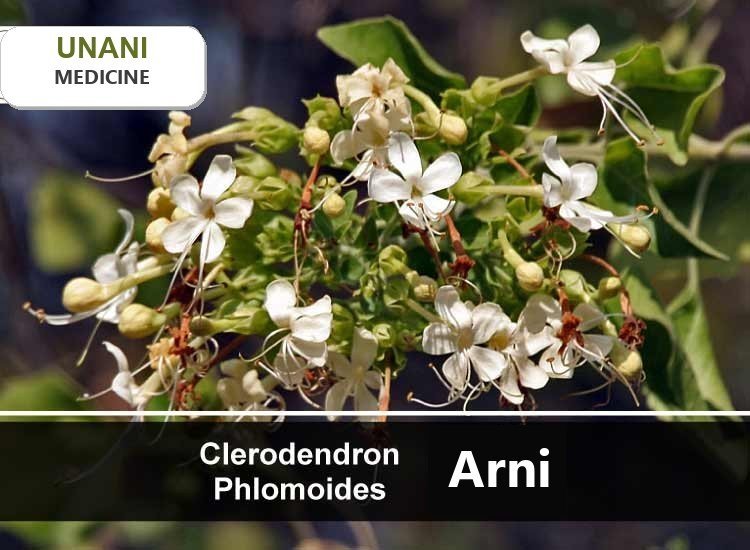
Arni (clero-dendrum phlomidis) has slightly hairy branches. Its leaves look umbrella-like. On the edges of the leaves are small saw-like teeth. The flowers of this tree have a pinkish tinge and give a faint pleasant fragrance. The fruits are about two to five inches in length and egg-like in shape and somewhat flat. They are also somewhat soft. Its fruits come in Chait-Baisakh as small round green fruits, turn earth-colored on ripening and finally black. The fruits fall at the beginning of the rains. In the small Arni white flowers come just as they do in the large Arni. The small Arni is called Kala Tekar. It is a part of the same.

Modern Research

Resin, bitter and alkaline constituents and a kind of alkaloid are found.

Dosage

Churan (powder): one to three grams. Juice of the leaves: ten to twelve grams.

Temperament (Mizaj)

Hot; the taste is bitter.

Benefits

Arni has an effect of stopping diarrhea. In Maharashtra its root is used as a tonic, which, though bitter, benefits in diseases like measles or smallpox (chhoti mata). A decoction of the root of Arni gives relief in diseases of the urinary passage and in toxic diseases. Many vaids and hakims use the leaves instead of the root. This juice, 10 to 12 grams, is given twice a day, an hour and a half after meals.

Uses of Arni

It is also used for the treatment of windy and black-bilious diseases and for removing phlegmatic disorders. By its use digestion becomes sharp and the wind of the stomach is expelled, so that diseases such as bloating are removed. It also proves useful in the treatment of deficiency of blood and bhas. In practice the bark of its root is used, but a decoction of its leaves is often given in stomach diseases, and rubbing its root in cold water and giving it to a patient with hives (chhapaki) cures him, while rashes and the like have come out on the body.

Grinding 5 grams of the leaves of Arni (clero-dendrum phlomidis) with 5 black peppercorns in water and giving it cures fever, and externally applying a poultice of its ground leaves or root bark on swelling or inflammations gives relief. Washing such places with a hot decoction is also often useful. Taking this same decoction cooled in a dose of 20 grams strengthens the heart, brain and stomach and is useful for swelling of the urinary passage. Using 10 grams of the juice of its leaves mixed with fifteen grams of honey removes every kind of corruption of blood.

In Ayurvedic medicine Arni is an ingredient in Dashmool Arisht (Sharangdhar).

From ancient times to today, Arni wood is used especially in havan to quicken the fire. In havan, to create fire, two pieces of this wood are often rubbed together. After some time, as a result of friction, a fire appears giving off a glow. For this reason Arni is called Agnimanth or Agnimanthi in Sanskrit. So in havan or yagya, pieces of the wood of this plant work quickly in producing natural fire and make the fire of the yagya brisk. In this way agnihotra yagya is brought into good harmony.

Easy Medicinal Formulas of Arni

Piles

In piles, making a decoction of Arni leaves and fomenting with it gives relief to the pain. For constipation, give 12 grams of ispaghol husk every other night with lukewarm milk.

Sprain

Grind Arni leaves in water and apply on the sprained place; besides this, its use is useful wherever there is pain.

Cough

Give 5 grams of juice of Arni leaves and 10 grams of pure honey twice a day. The cough will get relief.

Catarrh and Cold

Give 5 grams of juice of Arni leaves mixed with 5 black peppercorns ground, twice a day.

Hoarse Voice

Take 3 grams of Arni flowers as a powder with 250 grams of lukewarm milk morning and evening.

Menstrual Pain

Soak 2 grams of Arni root in 50 grams of water and take it morning and evening with milk.

Dashmool Arisht (Sharangdhar)

Arni (clero-dendrum phlomidis), shalparni, prishniparni, hardu katai, chhal bal, gokhru, kumbhari, padhal, shyonak (these ten medicines are called Dashmool), 250 grams each; chitra and pokharmool, one and a half kg each; lodh and giloy, one kg each; amla 770 grams, dhamansa 570 grams, and bark of khair, vijaysar and harad husk, 385 grams each. Kuth, majeeth, babrang, licorice, brangi, katha, post of behera, chavya, it sat, jata bansi, yerango, it mool, black cumin, nasot, kachur, rasna, pipal, supari, turmeric, fennel, padmakh, nag kesar, nagarmotha, indrajao, dry ginger, rishabak, meda, mahameda, kakoli, kheer kakoli, riddhi, vriddhi, jivak: 100 grams each.

Cut all the medicines coarsely and cook in 120 kg of water. When the water is reduced to 30 kg, remove and strain. Cook three and a quarter kg of raisins in 12 kg of water. When about 9.5 kg of water remains, remove and strain, add it to the first decoction, and add 20 kg of jaggery and one and a half kg of pure honey with it.

Also powder and add the following single drugs: gul dhawa one and a half kg; sarad cheeni, netr bala, white sandal, pipli, nutmeg, clove, cinnamon, small cardamom, tej pat, nag kesar, 100 grams each; musk 3 grams. When the arisht is ready, add 50 grams of powder of nirmali fruit (clearing nut) so that the sediment settles and clear arisht separates out.

Dose: 12 to 25 grams, mixed with an equal amount of water, after meals twice a day.

Benefits: It is useful in twisting of the mouth (facial palsy), numbness of a part of the body, tremor and flatulence (baogola). It removes weakness of the muscles. It is beneficial for jaundice, stomach diseases, piles, sangrahani (malabsorption), kidney and bladder stones, puerperal fever after childbirth and diseases of the womb. It gives women renewed health and strength. It is available everywhere under the name “Dashmool Arisht”.

Encyclopedia of Herbs by Hakim and Dr. Hari Chand Multani

Arni

Latin: Clerodendrum phlomidis.

Other Names

Arni (clero-dendrum phlomidis) or Aarni; in Hindi Arni, Arandi or Agathiyo; in Bengali Ganitiari; in Sanskrit Agnimanth; in Gujarati Arandi.

Description

Arni is of two kinds: a tree and a bush-like one. A particular sharp smell comes from its leaves. The leaves are soft. In the rainy season and in Chait and Baisakh (March and April) clustered flowers grow on it. The fruits are very small and round, the size of a pea. Inside them are several small seeds. The bark of this tree (clero-dendrum phlomidis) is soft and deep brown in color, from which a particular smell comes. In ancient times the rishis, on the occasion of havan and yagya, lit fire by rubbing the wood of this tree together and regarded this fire as very sacred. Therefore its Sanskrit name is Agnimanth.

Habitat

Commonly found on mountains and on the shores of seas.

Color

Flowers white; unripe fruit green, while ripe is black.

Taste

Bitter and sharp.

Temperament (Mizaj)

Hot in the first degree and dry in the third degree.

Uses

In the Coromandel region it is eaten as saag, and in some places these leaves are fed to animals as fodder. The Chakradatta states that eating the bark of the root of Arni ground with water, with ghee, for a week removes the trouble of hives (chhapaki, shitpitta). Its leaves rubbed with black pepper are useful in fever and cold. A decoction of Arni leaves or root bark corrects stomach disorders. The hill people of Sikkim get fire from it. If menstrual blood is flowing, it stops it and narrows the vagina. The powder of the leaves is useful in scrofula sores and other wounds, and in boils and pimples.

Dosage

On the advice of the physician (hakim).

Source: Taj-ul-Mufradat (Research) Khawas-ul-Adwiya, by Dr. and Hakim Naseer Ahmad Tariq.

More Unani herbs

  • Colocynth (Tumma / Indrayan)
  • Cotton Seed (Banola)
  • Country Mallow (Beej Band)
  • Croton Seeds (Jamal Gota)
  • Camel Thistle (Oont Katara)

Browse all herbs starting with C or the complete A–Z list of Unani herbs.

This information comes from classical Unani texts and is for education only. Please consult a qualified hakim or doctor before using any herb, especially during pregnancy or alongside other medicines.

You may also like

Senna (Sana Makki)

Sebesten Plum (Sapistan)

Scammony (Sakmunia)

Leave a Reply Cancel reply

Your email address will not be published. Required fields are marked *

Categories

  • A
  • B
  • C
  • D
  • E
  • F
  • G
  • H
  • Herbs
  • I
  • J
  • K
  • L
  • M
  • N
  • O
  • P
  • Q
  • R
  • S
  • T
  • U
  • V
  • W
  • Y

Copyright Unani Medicine 2026 | Theme by ThemeinProgress | Proudly powered by WordPress