
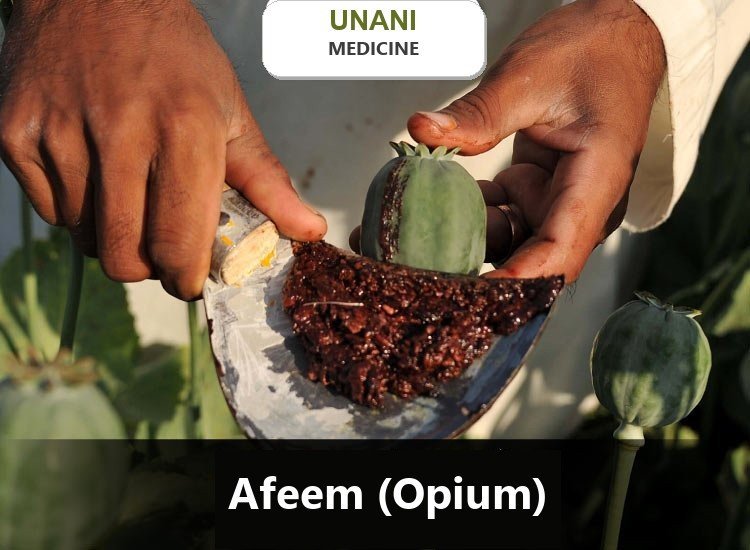
Opium (Afeem)
Afeem (Papaver somniferum) (Opium) is the dried latex of the poppy capsule, a powerful, habit-forming narcotic used in classical Unani medicine as a sedative and astringent. Its dangers are stressed.
Other Names
Afeem in Urdu; Afeem or Afyun in Hindi; Afeem in Bengali; Afu in Marathi; Afin in Gujarati; Afyun in Arabic and Persian; Aphuk and Ahiphena in Sanskrit; Opium in English; Papaver somniferum Linn in Latin. (Another source: Laban-e-Khashkhash (Afyun) in Arabic; Apu in Gujarati; Afu in Marathi; Abini in Tamil; Aphin or Ahiphen in Bengali; Afeem in Sindhi. Family: Papaveraceae.)
Identification
The plant (opium) is about one meter tall. It is called post (poppy, koknar), described in the third chapter of volume three of the Herbs of India. The poppy capsule (post ka doda) is round or oval. At the bottom is a neck and on top a crowned (serrated) cap. The color is yellowish brown with black spots here and there. Inside the capsule are chambers containing small white seeds. Opium is made from the coagulated milk of the green poppy capsule: the capsules are scored, their milk is drawn out and allowed to congeal. This is called opium, and it comes in round, flat cakes. Often poppy leaves are wrapped around it. In the fresh state opium is soft, moist, granular and reddish brown in color. The smell is strong, and the taste is intensely bitter and unpleasant. Since opium is made from the poppy, the supervision of poppy cultivation is entrusted to the Excise Department.
In more detail: when the petals of the poppy flower have fallen and the capsule is ripe, the fruit, that is the capsule, is scored, and the white milk (sap) that dries and turns black, or the material congealed on the dried fruits, is scraped off and collected. This is called opium. The poppy plant is annual, about three or four feet tall, with a green, soft, smooth, glossy stem, and broad, long, soft, serrated leaves. The flowers are white, blue or purple, cup-shaped and quite large. A month after the flowers appear, small capsules emerge from the middle of the flower and grow to two or three inches in diameter, first green and later yellow, with black spots on them. Then, in the afternoon, cuts are made all around these unripe capsules, not going into the inside of the capsule. A milk-like sap flows from the cut and is scraped off and dried the next morning. This is called raw opium.
Inside the capsules are small seeds, white or blackish, mostly white. White flowers give white seeds, red flowers give blackish seeds, and blue or purple flowers give black seeds. Capsules from blue flowers are somewhat smaller but contain more opium.
Habitat
In UP: Benares, Gorakhpur, Agra; in Madhya Pradesh: Indore, Bhopal; in Rajasthan: Kota, Jhalawar, Udaipur; and in Bihar and Assam; poppy is cultivated, and opium is prepared from it, in neighboring countries too. The main center of its production is the region of Afghanistan.
(Another source: in the northern hill areas of Pakistan (the Frontier province); in India generally in Rajasthan, Punjab, Uttar Pradesh, Madhya Pradesh, Malwa and Assam. It is also produced in Burma, Nepal, Persia and Egypt.)
Note: A license is needed to grow the plants, and it is looked after and collected under government supervision, though in some bungalows the plants are grown for the beauty of the flowers.
The peel of the fruit is called post khashkhash or post doda, the seed khashkhash, and the sap afyun (opium). All these parts are used as medicine.
Color: blackish brown. Taste: bitter and intoxicating.
Temperament (Mizaj)
Cold and dry in the fourth degree.
Actions
Hypnotic (munawwim), analgesic (musakkin-e-awja), strongly astringent to the intestines, retentive (mumsik), blood-retaining (habis-ud-dam), remover of seasonal fever, narcotic (mukhaddir), preventer of discharges (mani-e-nuzul), and worm-sedating.
Dosage
Half to one clove-weight; from the viewpoint of modern medicine, half a grain to one grain. (Another source: two rice-grain weights to one ratti.)
Harmful Effects
It is harmful for eyesight and sexual vigor. Saffron, castoreum (jund bedastar), cinnamon, dry ginger, zedoary (zadwar) and euphorbium (farfiyun) are considered its correctives.
Modern Research
By chemical experiments several active principles have been separated from opium, of which 18 are called primary and 8 secondary. In addition some neutral substances are found, but among all these active constituents there is one that is called morphine in allopathic medicine, and its injections are given to relieve pain, through which a writhing patient is very quickly relieved of pain. This injection is commonly known as "Morphia". Its use should be limited to special and critical conditions. Morphine or morphia is not a new medicine. It has been separated from opium. Unnecessary use of morphia makes one addicted to this intoxicant.
"Morphia injections can only be given by qualified doctors; ordinary practitioners are not permitted to give them." (Hakim Dr. Hari Chand Multani, Panipat)
Testing Genuine Opium
Sellers of opium add to it, to increase its weight, its leaves, powder of poppy seeds, starch, gum, rasaunt, aloe and so on, which makes it useless in medicines. Therefore Ayurvedic and Unani physicians should prepare medicines only after testing it.
Genuine opium should be tested by the following methods:
- Genuine opium begins to melt when placed in the sun and burns when put on the fire, but does not turn to charcoal. While burning, its flame is clean and without much smoke. When extinguished, a kind of sharp, intoxicating smell comes from it.
- Mix 0.2 gram of opium powder in 5 ml of chloroform and shake it well for ten minutes. After it is well mixed, add a few drops of dilute solution of ammonia. Then put it on a glass plate so that the chloroform evaporates. If one drop of formaldehyde and a solution of five drops of sulfuric acid are added to it, it turns thick and reddish.
- Good opium dissolves quickly when placed in milk. It burns when put on the fire but does not turn to charcoal. Smelling genuine opium for ten or fifteen minutes is enough to cause sleep.
Method of Purifying Opium
Opium should not be used without being purified (shuddh). To purify it, the following method should be used. Opium is dissolved in water, strained through cloth, and placed on the fire until thick. By this, opium is generally purified. Opium purified in this way is used externally, especially in diseases of the eye.
Think Before Using Opium
Its use is forbidden in children, the elderly, men and women alike. In children its use produces bad effects immediately. It should not be used in children. Many village mothers, because a child cries repeatedly and obstructs their work, give them some opium. This ruins their stomachs and stunts the child’s growth. This ignorance should be removed, and opium should never be given to a child.
Experts in Ayurvedic and Unani medicine have also forbidden the use of opium in the following conditions: 1. children, 2. the elderly, 3. diabetic patients, 4. cholera with a cold body, 5. influenza cough, 6. swelling of the kidneys.
Before using opium, attention must be paid to the following conditions, otherwise there is a risk of harm instead of benefit.
Essential Instructions
1. Age: In children its poisonous effects appear quickly, so as far as possible it should not be used in them. If used at all, it should be only in a small quantity.
2. Sex: In women the harmful effect is quicker and greater, especially in pregnant women and women in childbirth, so its use in them should be with great caution.
3. Temperament: People of phlegmatic temperament cannot tolerate it, so its use in them should be with great caution. With excessive use in them, sleeplessness and bad thoughts arise.
4. Continuous use: By continuous heavy use one becomes habituated to it, and the habit then grows so much that a larger quantity is needed.
5. Disease: In diseases with severe pain a larger quantity is needed, but in diseases of the heart, lungs, kidneys and brain it should be used with great caution.
6. Prescription: Its prescription should include ingredients that can remove its defects.
Ways of Breaking the Opium Habit
After eating opium continuously for a few days, a habit forms, and for the same benefit the quantity has to be increased every time. Opium eaters consume two ratti to eight ratti of opium. By this bad habit not only does one’s social position fall, but complaints arise such as muscle weakness, fatigue, weak pulse, tremor, digestive disorder, sleeplessness, sexual weakness and contracted pupils of the eyes. But if the opium eater’s opium is stopped, there are troubles such as tension, agitation, restlessness, stomach pain and burning.
To break the opium habit, the quantity of opium should be reduced gradually; make pills of opium with purified kuchla (nux vomica), chiraita and black pepper and so on, and gradually reduce the opium in the pills. By this the opium habit will go away.
Tried prescriptions for opium eating (Opium Habit) are as follows:
- Use sweet nirbisi (zedoary) in proportion to the opium, and decrease the quantity daily, reducing it completely in a month.
- Give purified kuchla in a quantity suited to the temperament, and reduce opium in a suitable amount daily, giving it up within a month.
- Give Majun Barshasha (in which opium is included as an ingredient) according to the amount of opium, and gradually give up the opium by reducing it daily by a suitable amount.
- Take 30 grams of purified black datura seeds and 20 grams of dry ginger, and grind everything finely into a powder. Then dissolve 10 grams of acacia gum in enough water that, when mixed with the powder, it can be made into pills, and make pills the size of a black pepper. At the time of eating opium give one pill. In a few days the opium habit will be gone. By this prescription the opium-eating habit is broken without harm.
Treatment Without Medicine for Giving Up Opium
Take as much opium as one eats in a month, put it in a clean vessel, and, if one eats opium once a day, add 30 spoons of water, or if twice a day, 60 spoons of water, and put it on the fire. When it comes to a boil, the water added should remain. Now take it off and fill a bottle with it, and add rooh kewra (screwpine essence) to change its smell. The medicine is ready. The method is that when it is time to eat opium, shake the bottle, take out one spoon and give it to drink, and add one spoon of plain water to the bottle. After some time the opium habit will be gone and plain water will be seen in the bottle. It is tried and tested.
Homeopathic Treatment for Giving Up Opium
Oats and barley: horse keepers feed green oat grass to horses to make them plump and strong. The medicine made in alcohol from the oat plant is called Avena sativa. By giving 10 to 20 drops per dose, 3 to 4 times a day, the habit of opium eaters and drinkers of 20 to 30 years’ standing can be broken.
The American doctors Clarke, M.D. and Burke have praised this medicine highly. If a person eats 2 ratti of opium daily, he is given opium and then 15 drops of this medicine mixed in lukewarm water four times a day. If he eats more opium, his opium is reduced little by little and the same medicine is given. In addition this medicine is also useful in removing sexual weaknesses.
Uses (Unani Texts)
Because it is narcotic and analgesic, it is used to soothe headache, nerve pain, pleurisy, back pain, joint pain, toothache, earache and eye pain, sciatica and pains of all the organs. Because it is hypnotic, it is given in sarsam (brain fever), melancholia, insanity, wakefulness and so on, and in internal pains, by which the patient falls asleep. Acting on the mouth of the stomach and on the intestines, it reduces moistures, owing to which the throat and tongue become dry; that is, with internal use sensation, movement and the secretion of moistures decrease. Appetite is reduced. It soothes pain in the stomach and stops vomiting, and if opium is given in large quantity, vomiting is not produced even by emetic medicines such as mustard. Acting on the intestines, it halts their peristaltic movement and causes severe constipation and removes pain. Acting on the liver, it slows its function, so that bile secretion stops and the stool becomes clay-colored and bland. Besides jaundice occurring, the amount of sugar, urea and carbolic acid in the urine decreases.
If opium is given in small quantity, the heart’s movements through the nerve center are initially quickened; if the quantity is large, the movement becomes slow and the pulse weak and feeble.
Because it is astringent and retentive, it is used for diarrhea, dysentery and to stop bleeding; but remember that when dysentery is due to obstructions (sudda), it is better to expel the obstructions by a purgative.
Because it is narcotic and analgesic, it is used in all kinds of cough, especially cough that comes repeatedly because of nervous irritation with little phlegm. But when the bronchial tubes (airways of the lung) are full of phlegm, opium is harmful in that case. Because it prevents catarrhal discharges, it is used in chronic catarrh and colds.
Because it is retentive, opium has a special place in retentive medicines and premature ejaculation, but the Master of the Sages (Ustad-ul-Hukama) said that true retention is that which is without opium.
It is also used to prevent miscarriage. It is also given to relieve pain after miscarriage or childbirth. "Since opium is cold and dry in temperament and is also retentive, in my opinion it should not be used for pains after childbirth, because it will also stop the lochial blood, which may cause other troubles." (Hakim Naseer Ahmad Tariq)
Note: By using opium continuously for some time, the patient becomes habituated to it, and giving it up becomes not only difficult but impossible.
If opium is to be added to a powder or electuary, it should be roasted on the fire and ground fine, or dissolved in a suitable distillate and added to an electuary and so on.
In earlier times mothers used to give opium to children in very small quantity. Now it is hard to obtain, so it is not used much, but opium affects a child very quickly, so caution is essential.
Symptoms of Opium Poisoning
Insensibility, contracted pupils, cold and clammy skin, bluish face and lips, weak, slow and irregular pulse, snoring breathing, and finally the breath becomes slow and stops.
Toxic effects: A large quantity of opium is poisonous. After eating opium in a poisonous quantity, unconsciousness quickly sets in. At first the poisoned person can be awakened by shaking, pinching or loud rousing, but soon such deep stupor sets in that he cannot be woken in any way. The pupils of the eyes contract greatly. The skin becomes cold and clammy. The face and lips are bluish, the pulse very weak and slow, the breathing slow, irregular and snoring, and finally death occurs through stopping of the breath. A few minutes before death the pupils dilate.
Difference Between Opium and Alcohol Unconsciousness
In opium poisoning the pupils of the eyes contract, but in alcohol poisoning they are at their natural state or are more dilated.
The treatment of a patient who has eaten opium or any poison should not be taken into one’s own hands, because several kinds of complications arise from it. Registered Ayurvedic and Unani physicians can obtain a quota of opium. For this an application should be made to the Excise Department, but after obtaining opium, it is also obligatory to keep an account of it. (Hakim Dr. Hari Chand Multani, Panipat)
Treatment of the Poisoned
Through a stomach tube (gastric lavage) or by inducing vomiting, and give potassium permanganate in an equal weight (as much as the morphine or opium eaten), dissolving the potassium permanganate in water. Do not let the poisoned person sleep. Keep him awake by pinching him. Keep sprinkling cold water on the head, chest, abdomen and so on. Let him smell ammonia and give a quick injection of atropine. Remember that potassium permanganate is useful only as long as opium or morphine is present in the stomach; afterwards it has no effect. In such a case, giving castoreum, asafoetida or saffron mixed in water will remove its effect.
Chemical Properties
Morphine about five to twelve percent, codeine three to four percent, thebaine three percent, papaverine 0.5 to 1 percent, narcotine 0.2 to 1 percent, and also pseudomorphine, codamine, cryptopine, laudanosine, gnoscopine, protopine, meconidine, lanthopine, hydrocotarnine, rhoeadine and others. Secondary alkaloids: pyomorphine, oxydimorphine, apocodeine, desoxycodeine, thebenine, cotarnine, rhoeadine, porphyroxine; in addition about sixteen percent glucose, fats, volatile oil, calcium salts and aromatic constituents and so on.
History of Opium
This medicine reached China, India and Pakistan through Arab Muslims, since historical evidence shows that opium has been in use since the fourteenth century CE. The Mughal emperor Jalaluddin Akbar had to enforce laws to bring regularity to the opium trade.
In Pakistan the number of opium addicts was about eighty-six (86) lakh (8.6 million, as given in the source), and the situation in the North-West Frontier Province was worse than this. These figures are from 1987 or 1988, since now it is scarce, that is, difficult to obtain, so their numbers have decreased; in any case people use the modern intoxicant "heroin" instead of opium.
Excretion of Opium
With slight retention in the urine, morphine is found in the urine. That is, it is very little digested and is excreted through the urine after changing into "oxydimorphine".
Special Benefit
Hypnotic, analgesic, retentive.
Side Effects
Sexual weakness and disturbance of the outer and inner faculties.
Corrective (Muslih)
Castoreum (jund bedastar), saffron, milk, ghee and so on.
Substitute (Badal)
Ajwain Khurasani (henbane seed).
Dosage
Two rice-grain weights to one ratti.
Famous Compounds
Majun Barshasha, Hab-e-Pechish, Hab-e-Sill, Qurs-e-Musallas, Hab-e-Sual-flu (Tibb-e-Nabawi Dawakhana). Besides being a medicine for colds, cough and a pain-reliever, I use this with children as a worm-killer. One pill at night before sleeping with a cup of milk; by it the intestinal worms are rendered insensible and are expelled with the stool. This is a personal experience. (Hakim Naseer Ahmad Tariq)
Pure Opium
Pure opium burns when set on fire and dissolves in pure water. Some people also mix aloe or rasaunt into opium. Its potency lasts up to fifty years. (It is a deadly poison.)
Home Remedies and Formulas (Classical)
These are classical formulas from the source text. Opium is a dangerous, habit-forming and legally controlled substance; this text is for information, not an endorsement of use.
Hab-e-Afyun
Pure opium, black pepper, red rose petals (gul-e-armani) and purified kuchla, 6 grams each. Grind everything fine and make pills the size of a mung bean. Give two pills with cold water. Useful in diarrhea, sangrahani and dysentery.
Method of Purifying Kuchla
Put the required amount of kuchla in a vessel at night and add water so that it stands two finger-widths above the kuchla. In the morning boil them; when all the water has dried and the color of the kuchla turns black, peel them, split them in two, remove the sprout inside, wash them in clean water, fry them in pure ghee and then use them.
Pills for Male Vitality
Pellitory (aaqarqarha), purified Roman cinnabar (shangraf rumi), clove, saffron, cinnamon, nutmeg, opium and pure musk, all in equal weight, ground with betel leaf juice and made into pills of one ratti each. Dose: one pill with lukewarm milk, taken an hour beforehand. Avoiding sour things is essential.
Another
Take one whole coconut kernel, make a hole in it on one side, and put in 25 grams of talmakhana and 3 grams of opium, ground, and fill it up with the milk of the banyan tree (bargad). After that place the removed piece on top, wrap rags of cloth around it and bury it in a heap of wheat grain. After 40 days take it out and grind it well, and make pills the size of a wild jujube. Give one pill daily with cow’s milk. With a week’s use the benefit will be of the highest degree. Give one pill with lukewarm milk 2 hours beforehand. Avoiding sour things is essential.
Another
Opium, pellitory, nutmeg and purified Roman cinnabar, 3 grams each; pound fine and sieve, and with the help of pure honey make 20 pills. Use one pill with lukewarm milk three hours before need; it is useful. Use of sour things is forbidden.
Hab-e-Haiza (Cholera Pills)
Pure opium 20 grams, camphor 10 grams, pure asafoetida and red chili seeds, 10 grams each. First grind the red chili in water until it becomes like wax. Then add the asafoetida and grind. Afterwards add the opium and finally the camphor and grind so that everything is fine, and make pills the size of a mung bean.
Give a young man one to two pills with water according to temperament and age.
Besides cholera diarrhea, they are also useful for bloody diarrhea and stomach pain.
Safoof-e-Afyun
Pure opium two parts, black pepper four parts, dry ginger ten parts, black cumin twelve parts, gum tragacanth one part. Grind each separately fine and mix. Give one to two ratti with poppy syrup. It is extremely useful for stopping pains.
Ointment for Piles
Opium 30 grains, green oak gall (mazu) one dram, Vaseline 1 ounce. Make a powder of the opium and mazu and mix into the Vaseline to make an ointment. After passing stool, apply a small amount with the finger on the anus. It is useful and tried for bleeding piles. It stops blood and is useful in pain and inflammation.
Joint Pain
Mix 125 grams (as given in the source) of opium into egg white and apply on the painful place. It is useful for back pain, kidney pain and joint pain.
Another
Mix two grams of opium, 25 grams of coconut oil and 25 grams of sesame oil together and keep it. When needed, massage on the painful place.
Hab-e-Pechish (Dysentery Pills)
Pure opium 5 grams, borax (suhaga) 10 grams, purified cinnabar 10 grams. Make pills the size of a chickpea with water. Dose: 1/2 to one pill daily with water. Useful for stopping diarrhea and for dysentery. Its use is forbidden for children.
Hab-e-Siyah (Eye Pills)
Purified rasaunt 57 grams, roasted alum 27 grams, opium 12 grams, ten neem leaves, pure saffron 5 ratti. Put all the medicines in an iron pan, add a little water and grind well so that all the medicine dissolves. Then put the pan on the fire; when the medicine becomes fit for making pills, take it off the fire, let it cool, and make pills and keep them. Rub one pill in poppy-husk water and apply on the eyelids. Do this three times in the day and night. It is useful for conjunctivitis (ashob-e-chashm). It removes redness and pain of the eyes, but do not use this prescription at the beginning of conjunctivitis.
Another
Dissolve 3 ratti of opium and 2 grams of alum in 60 grams of rose water and keep it. With a dropper put two or three drops in the eyes morning and evening. It is useful for sore eyes and granulations (kukre).
For the Desire for Children
Musk 2 ratti, saffron one gram, one nutmeg, hemp (bhang) 1 3/4 grams, 3 betel nuts, 4 cloves, old jaggery 5 1/2 grams. Pound and sieve all the medicines and make pills the size of a chickpea mixed with the jaggery. Give one pill in the morning and one in the evening with lukewarm milk. In this way give it for seven days after the menses have dried up each month.
Use of Opium in Kushtas
Kushta Jast (Zinc)
Take 125 grams of zinc, melt it in a pan, and add one gram of opium little by little, rubbing it with an iron handle. When it has become ash (bhasm), take it off, grind it fine and sieve through cloth. It is extremely useful for the eye diseases phoola (corneal opacity) and kukre (trachoma).
Ayurvedic Compounds Made with Opium
Karpura Rasa (Bhaishajya Ratnavali)
Pure opium, purified cinnabar, camphor, nut grass (mutha) and nutmeg in equal weight; grind everything with fresh water and make pills of one ratti each. Give one pill with rice-wash water or fennel distillate two to three times a day.
Benefits: It is useful in bilious and bloody diarrhea. It is also an unmatched treatment for cholera and sangrahani. If gas is felt in the stomach from the use of this medicine, boiling fennel in water, straining it and giving it to drink expels the wind.
Shakroti
Mace, cinnamon, pellitory, samundar sookh and pure opium, twelve grams each. Make a powder of all the medicines, mix with 75 grams of rock candy (misri kuza), grind with honey, and make pills of two ratti each, dry them in the air and keep them in a bottle. It is better to put rock sugar or honey in the milk in place of sugar.
Benefits: It thickens semen like honey and is useful for male vitality. When needed, give one pill with lukewarm milk three hours beforehand. It is astringent and brings sleep. Use of sour things is strictly forbidden.
Aaqarqarha Adi Churna
Pellitory, dry ginger, sard chini (cubeb), saffron, mugha, nutmeg, clove and white sandalwood, 10 grams each; opium 40 grams.
Make a fine powder of everything. Use one to two ratti with lukewarm milk and honey three hours beforehand, and give lukewarm milk on top. Do not use sour things after its use.
Ahiphena Asava (Bhaishajya Ratnavali)
Five kilos of mahua liquor, 192 grams of pure opium, and 50 grams each of nut grass, nutmeg, indrajau and small cardamom (make a powder of the last four medicines). Put everything in a glass vessel. Give five drops with fennel distillate every three hours. It is useful for diarrhea, dysentery, vomiting, cholera, stomach pain and indigestion. If its use causes bloating, boil a little fennel in a cup of water, strain it and give it to drink.
Gangadhara Rasa (Rasa Raj Sindoor)
Purified mercury, purified sulfur, pure opium, nagarmotha, indrajau, mocharas, dhava flowers and lodh pathani, in equal weight, ground in water and made into pills of one ratti each. Give one to two pills with milk or fennel distillate an hour and a half after eating.
Benefits: It is useful for old dysentery and diarrhea; if blood or mucus comes with the stool, it stops it at once and restores health. (This is beneficial only in old dysentery and old diarrhea.)
Kamini Vidravana Rasa (Bhaishajya Ratnavali)
Purified cinnabar and purified sulfur, 5 grams each; pure opium 80 grams; pure saffron, nutmeg, mace, pellitory, dry ginger, black pepper, clove and red sandalwood, 20 grams each. First mix the cinnabar, sulfur and opium together, then powder the remaining medicines, grind everything in betel leaf juice for six hours and make pills of one ratti each. Give one pill in the evening with lukewarm milk.
Benefits: This rasayana removes thinness of semen and makes semen strong and thick. Use three hours beforehand when needed. It is very useful for male vitality. Use of sour things is forbidden.
Since this rasayana contains opium, it should not be used continuously, otherwise there is a risk of becoming habituated to the opium intoxication. Therefore use without need is forbidden. (Hakim Dr. Hari Chand Multani, Panipat)
Majun Barshasha
Its meaning is "one that gives immediate relief". It is a famous medicine of Unani medicine. It is useful for catarrh, colds, chronic cough, forgetfulness, melancholia and tremor. The euphorbium and opium given in the prescription should not be ground together; otherwise they will cancel each other and the effect of both will be lost.
White pepper, black pepper and ajwain Khurasani (henbane seed), 50 grams each; pure opium 25 grams; genuine saffron 13 grams; spikenard (sumbul-ut-teeb), pellitory and euphorbium, 3 grams each.
Pound and weigh all the medicines separately, mix them into a syrup of honey three times the weight of the medicines and keep it in barley grain for three months. Then take it out and use.
Dose: one ratti to two ratti with lukewarm milk.
Sources
Encyclopedia of Herbs by Hakim and Dr. Hari Chand Multani; Taj-ul-Mufradat (Research on Khawas-ul-Adwiya) by Dr. and Hakim Naseer Ahmad Tariq.
Leave a Reply