
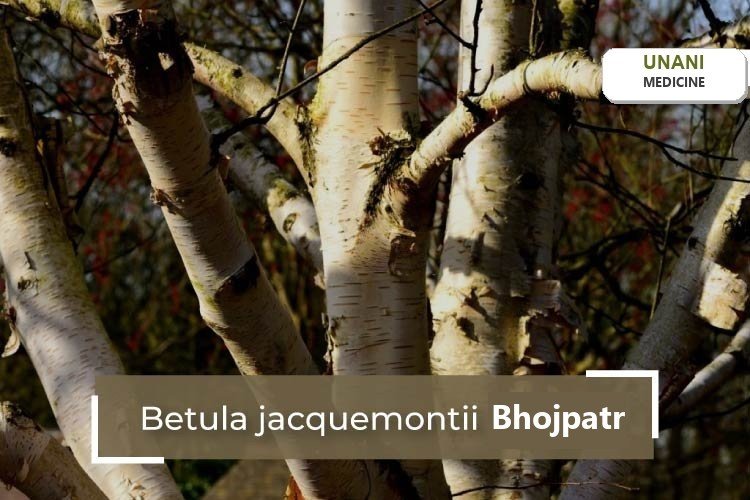
Himalayan Birch (Bhojpatr)
Bhojpatr (Betula utilis (Betula bhojpattra)) is the bark of the Himalayan birch, cold and dry in temperament, used externally and internally in several traditional remedies and historically as a writing material.
Other Names
Urdu and Hindi: Bhojpatr. Sanskrit: Bhurja-patra. Bengali: Bhojpatri. Telugu: Bhoja-patri. Persian: Toz. English: Jacquemont’s Birch (Himalayan birch). Latin: Betula bhojpatra.
Habitat
Found in the temperate regions of the Himalayas (Himalayan birch), from Kashmir, at altitudes of 7,000 to 12,000 feet.
Identification
The tree grows 25 to 30 feet tall with branches. It remains covered with snow for six months of the year. The bark peels off in sheets; it is soft and comes off easily. It flowers in June. Its leaves are silky in colour and later become smooth. The leaves are 5 to 10 centimetres long, oval, pointed and saw-toothed.
In ancient times the dried bark of bhojpatr (Himalayan birch) was used especially for writing. Because of this quality, one Sanskrit name of bhojpatr was “Lekh-varikh”, meaning the writing tree. In those times valuable documents and books were written on this bark.
In India and other countries, books written on bhojpatr are still preserved in ancient libraries. Its bark is regarded as very pure, and religious texts and horoscopes were preferably prepared on bhojpatr.
Amulets written on bhojpatr to protect against evil spirits are still used in our country today.
Forests of bhojpatr (Jacquemont’s birch) trees look very beautiful. Old bark keeps peeling off the thick branches of the trunks by itself, and falls here and there and is wasted. Bhojpatr has a special place in the life of the people living in the Himalayan region. It is used like a mat in places of worship. In ancient times ascetics used it as clothing to protect their bodies. The wood of the bhojpatr tree is very strong. People of the Himalayas buy bhojpatr wood and make very beautiful vessels from it.
According to modern research, a volatile oil has been separated from the bhojpatr tree, whose fragrance alone gives considerable scope for its use in the oil industry.
Taste
Pungent (charpara) and astringent.
Temperament (Mizaj)
Cold and dry.
Dosage
As appropriate.
Benefits
Removes bile, corruption of the blood and toxic effects. In hysteria of the womb (ikhtinaq-ur-rahm), a decoction of bhojpatr bark is prepared, strained and given to drink. Besides this, bhojpatr is also useful in the treatment of snake venom. If the bark is used as a fumigation on smallpox eruptions, no itching arises, and if a decoction of the same bark is strained and syringed into the ear, the sore is cleaned and ear pain is relieved immediately.
If the bark of bhojpatr (Jacquemont’s birch) is soaked in water and then strained, the distillate (arq) obtained is anti-bacterial and carminative (dafi-e-riyah).
Even today, pilgrims visiting Kedarnath and Badrinath take home a staff of bhojpatr and consider it auspicious to keep it in their homes as a blessing.
Bhojpatr for Birth Control
On old trees of bhojpatr (Himalayan birch), a fungus called Bhoja-goda grows, and this fungus acts as a birth-control medicine by preventing pregnancy.
The Assistant Director (Ayurveda) of the Central Council for Research in Ayurveda and Siddha has stated through his research that this fungus can be used as a successful contraceptive.
The bark of the bhojpatr tree is used as medicine in the treatment of epilepsy, a disease considered incurable. Mixing bhojpatr bark, the root of Jatamansi and the root of Vratkosh (a climber) and having the patient smell it brings the patient back to consciousness.
The leaves of bhojpatr (Jacquemont’s birch) are very useful in washing severe wounds. Washing wounds with a decoction of bhojpatr bark heals blisters and wounds.
For ear sores, straining a decoction of bhojpatr bark and syringing the ear with it heals ear sores.
Giving the patient a cold infusion (phant) of bhojpatr (Himalayan birch) bark removes bloating. In villages of Garhwal, Sikkim, Arunachal Pradesh, Himachal Pradesh, Kashmir and areas near the Himalayas, it is still believed today that if a child is struck by the evil eye, bhojpatr leaves are held to the child’s nose and an amulet of it is put around the child’s neck so that the child remains protected from the evil eye.
Encyclopedia of Herbs, by Hakim and Dr. Hari Chand Multani
Bhojpatr
Persian Name
Toz
Description
From a mountain tree (Jacquemont’s birch) that grows fifty to sixty feet tall. Its bark is like mica, and all its layers are light and delicate like paper. One can even write on its bark. Its leaves are long and serrated. On both sides of the vein of its seed there is fine down. Colour: reddish. Taste: pungent and astringent.
Habitat
Kashmir, Sikkim, the Himalayas and Bhutan.
Temperament (Mizaj)
Cold and dry.
Uses
If the bark (Jacquemont’s birch) is used as a fumigation on smallpox eruptions, there will be no itching. Syringing the ear with a decoction of its bark cleans an ear sore and benefits ear pain (Himalayan birch).
Dosage
It is for external use only.
Source: Taj-ul-Mufradat (research of) Khawas-ul-Adviya, Dr. and Hakim Naseer Ahmad Tariq
Leave a Reply