
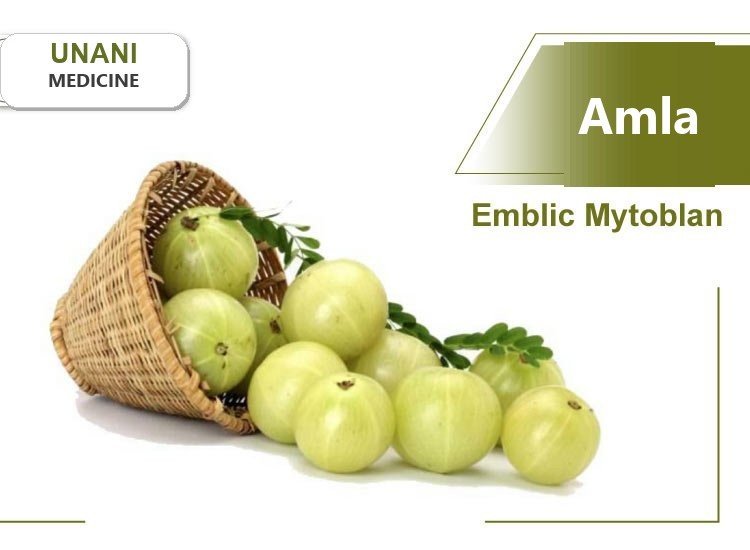
Indian Gooseberry (Amla)
Amla (Indian gooseberry, Phyllanthus emblica) is a vitamin C-rich fruit used in Unani and Ayurvedic medicine as a tonic for the heart, brain, stomach, eyes and hair.
Other Names
Well known as Amla (Hindi: Anwla; Sanskrit: Anvara; Gujarati: Anvla; Bengali: Amla). Latin: Phyllanthus emblica (emblic myrobalan).
Identification
It is a famous tree of Pakistan and India, generally found in hilly places. Amla is a well-known fruit, about the size of a walnut or a little smaller, round in shape. When fresh its colour is yellowish brown, with faint lines of segments on the surface; when dry it becomes blackish and the lines are not prominent. Fresh it is sour and astringent, and when dried it has a slight bitterness. According to modern research it contains vitamin C.
Benefits
It is harmful for the bladder and spleen and causes colic in the stomach. Its harm is removed by almond oil, fresh milk and pure honey. It is a tonic for the nerves, an exhilarant for the heart and brain, and strengthens the stomach and gums. It improves eyesight. Externally it strengthens the hair and keeps it black. It causes constipation and is useful in dysentery and diarrhoea.
Taking amla powdered with an equal weight of turmeric, 9 masha daily with cow’s milk, is extremely useful for swelling of the urinary passage. To stop nosebleed, its thick paste should be applied to the forehead. For the eyes, put the juice of fresh amla in the eye.
Tried Preparations of Amla
Amla Hair Oil
Boil one ser of amla in two ser of water. When half a ser of water remains, strain well and set aside, mix this water with four ser of refined sesame oil and put on fire until all the water has burned away. Then take it off, cool and strain. Adding a little amla fragrance gives it more scent.
Compound Amla Hair Oil
Dry amla without stones 10 tola, Brahmi 10 tola, Nagarmotha 1.5 tola, Bal Chhar (spikenard) 1.5 tola, dry coriander 10 tola, henna leaves 10 tola, white sandalwood sawdust 10 tola.
Soak all the items in five ser of water. First pound all the things a little. Let it stand for a day and night. On the second day add five ser of pure washed, refined sesame oil, put it on fire in a large vessel. Keep the fire low or the oil will boil over. When the water has evaporated, take the oil off the fire, strain it and colour it; add an oil-soluble colour of your choice, strain and add. A top-quality oil will be prepared.
Amla Hair Oil (second method)
Buy ten or twelve ser of fresh (green) amla and extract the juice in a press or a drug-pounding vessel. Mix this with ten ser of white sesame oil and heat on fire. The fire should be low. When all the juice is finished, take the oil off, strain and let it cool. The next day add three ounces of amla fragrance and three ounces of benzyl acetate and colour the whole oil as desired with green oil colour. A good-quality amla hair oil is ready. Fill into bottles, label and sell.
Brahmi Amla Hair Oil
Juice of green amla half a ser, coriander juice one pao, black Bhangra juice one pao, good Khas one pao, fresh rose flowers one pao, Pani one pao, white sandalwood sawdust one pao, Bal Chhar 5 tola, Brahmi herb half a ser.
Method: Soak all these things, except the juices, in ten ser of water overnight. Boil in the morning. When the water is reduced by half, strain it and mix in the above-mentioned juices and five ser of washed sesame oil, and cook on a very gentle fire until only the oil remains. Now put this oil in a clean tin. Add 3 masha each of Itr Hina, Itr Gulab and Itr Motia, close the mouth and keep. Use after a week. The best Brahmi Amla hair oil is ready; if you want to colour it, add green oil colour.
Sharbat Amla
One ser of amla juice and two ser of cow’s milk. Mix both and put on fire in a tinned vessel. When the milk curdles, take it off and strain, add white sugar equal to the amla juice and prepare a syrup. Take two tola of the syrup with six tola of fennel distillate or three masha of Khamira Gaozaban Ambari. It is useful for dizziness. It gives freshness, delight and strength to the brain.
Murabba Amla
Special Banarasi Murabba Amla is famous. Its benefits are also superior. Physicians recommend it to patients for strengthening the heart. Amla contains all kinds of vitamins. Its preserve is prepared by the following method.
Take four ser of good Banarasi amla and wash them. Prick them well with a wooden skewer. Then soak them in lime water. Change this water every second day. After four or five days remove the lime water and wash them well seven times with fresh water. Now put them in water and set on fire. When they have had one or two boils, drain the water. Now take eight ser of sugar and make a murabba syrup. Put the cooled, dried amla into this hot syrup and cook. When the amla is soft and the syrup is ready again, take it down, add small cardamom and the like, and put it in sterilised jars.
Wash one amla in water, wrap it in silver leaf and eat it. It strengthens the brain, stomach and liver. It removes obsessive thoughts (waswas), creates delight, and benefits dizziness, diarrhoea and piles.
Amla Pills for Cataract (pani chashm)
Take equal weights of amla seed kernel and yellow Harar seed kernel, grind in water for three pahar and make chickpea-sized pills. Eat two pills daily at bedtime. By using them the cataract (water in the eye) is arrested.
Amalakyadi Churan
Amla (stone removed), Maghan (long pepper), Chitrak root bark, yellow Harar peel and Sendha salt in equal weight. Make a powder of all the drugs. Dose: two to three masha with hot water two to three times a day.
Benefits
It is useful for all kinds of fevers. It is a laxative and digestive, relieves phlegm and indigestion. It creates a good appetite. It brings clean motions. If a mild fever persists, this churan is extremely useful.
Jawarish Amla
It strengthens the stomach, removes palpitation of the heart and stops bilious diarrhoea.
Amla 8 tola, white sugar candy one ser. Keep the amla soaked in one ser of cow’s milk for 24 hours. Afterwards wash the amla, boil it in water, rub and strain, add the sugar to the same water and make a syrup (qiwam). Dose: six masha in the morning and six masha in the evening with borage distillate or water. Avoid foods that are slow to digest and windy.
In Ayurvedic medicine, Chyawanprash is a compound of amla, useful for cough, asthma and weakness.
Source: Encyclopedia of Herbs, by Hakeem Dr. Hari Chand Multani.
Amla (Anwla), Emblic Myrobalan: Further Description
Other Names
Hindi and Gujarati: Anbla. Persian: Amla. Arabic: Amlaj. Sindhi: Anwara. Sanskrit: Shriphala, Amritphala and Amalaka.
Family
Euphorbiaceae.
It is a tree known in Pakistan and India since very ancient times and holds a very high place in Ayurveda.
Description
The tree is small or large in different places: the wild tree is large, but the grafted tree, called Banarasi, is small.
The trunk is crooked and of hard wood, and the bark on it is about a quarter of an inch thick, whitish like ash, and is shed every year. The fruits are like paper lemons, small to large but round, naturally divided into six segments. The skin of the fruit is very thin, and inside is a hard stone with six raised parts. The fruit of amla is green in August and September and then yellow or reddish yellow from November to January. Its weight is generally 25 grams, but the grafted Banarasi amla weighs more than 50 grams. The large amla is generally used for murabba, while the small amla is dried for medicines. The leaves, after autumn, in March and April, appear on the branches as greenish-yellow, very small clusters, and they smell like lemon fruit.
Habitat
Generally grows in gravelly and rocky soil, and also near the sea coast.
Colour
Fresh: brown but greenish yellow; dry: blackish blue with wrinkles on it. Taste: at first sour and astringent but afterwards it tastes sweet.
Temperament (Mizaj)
Cold in the first degree, dry in the second degree.
Actions and Properties
Tonic of the principal organs, stomach tonic, sedative of the heat of bile and blood, eye tonic, hair-strengthening and blackening, astringent, mild diuretic.
Uses
It sharpens memory and the brain. Besides strengthening eyesight, amla is used extensively to relieve palpitation, weakness of the heart and weakness of the stomach. Besides calming the agitation of bile and blood, it is useful for quenching thirst and stopping diarrhoea. Amla water or extract is prepared and put in the eyes for strengthening the eyes. Washing the hair with an infusion or decoction of amla makes the hair strong and black. Because of vitamin C (lime constituents) it gives strength to the heart, brain and muscles. It is a tonic for the womb and the eyes. It dries excess moisture of the organs and is useful in high blood pressure, provided the blood pressure is not very high. Because it contains a sour acid it creates appetite, but it has no special effect on the intestines. It reduces the congestion of blood towards the brain, so it is useful in headache, flatulence of the stomach, melancholia and paralysis. As a poultice and gargle it is useful in nosebleed and bleeding piles. Because of vitamin C it is beneficial in running boils and pimples; if it is mixed with neem leaves and given with water, it is a blood purifier. A gargle of its decoction is useful for swelling of the gums, ulcers and mouth thrush. It is useful in palpitation of the heart. Besides preventing hair loss, its oil makes the hair (oily parts) black. Jawarish Amla is its famous compound, which strengthens the stomach and is a well-known beneficial medicine for stopping diarrhoea, palpitation of the heart and flatulence of the stomach.
Its murabba and pickle are also made, which are useful for relieving palpitation, weakness of the brain and weakness of the stomach. The bark of the amla tree is also astringent and is used in tanning leather.
According to Modern Research
Compared with all vegetables and fruits containing vitamin C, amla contains the most vitamin C. One kilo of fresh amla contains six thousand units of vitamin C and five hundred calories. Besides vitamin C, amla also contains some iron, and the following constituents, whose proportion is ten percent: tannin, gallic acid, glucose, calcium and tannic acid.
This analysis shows that it is a very useful medicine for pyorrhoea (gum disease), leucorrhoea and the diseases mentioned.
Special Benefit
Tonic of the principal organs, for bleeding gums, checks diarrhoea, and stomach tonic.
Side Effects
Causes constipation and colic.
Corrective (Muslih)
Honey, almond oil.
Substitute (Badal)
Halela Kabuli, only in strengthening the stomach.
Dosage
Three to five masha, that is, grams.
Compounds
Jawarish Amla Sada, Jawarish Amla Ambari (Nuskha Kalan), Jawarish Shahi, Roghan Amla and Roghan Gesu Daraz; it is an essential ingredient in every kind of Itrifal.
Note: Because of the properties of amla, amla shampoos and amla oils are abundant in Pakistan and India nowadays.
Compounds in Ayurveda
Anushadar, murabba and Chyawanprash are famous compounds.
Hakeem Ashfaq Ahmad Ashraf (former principal, A. R. Tayyiba College, Lahore) prepares a jawarish from amla for flatulence of the stomach, named Kala Khamira, which is extremely popular and useful.
Source: Taj al-Mufradat (research on Khawas al-Adwiya), by Dr. Hakeem Naseer Ahmad Tariq.
Leave a Reply