
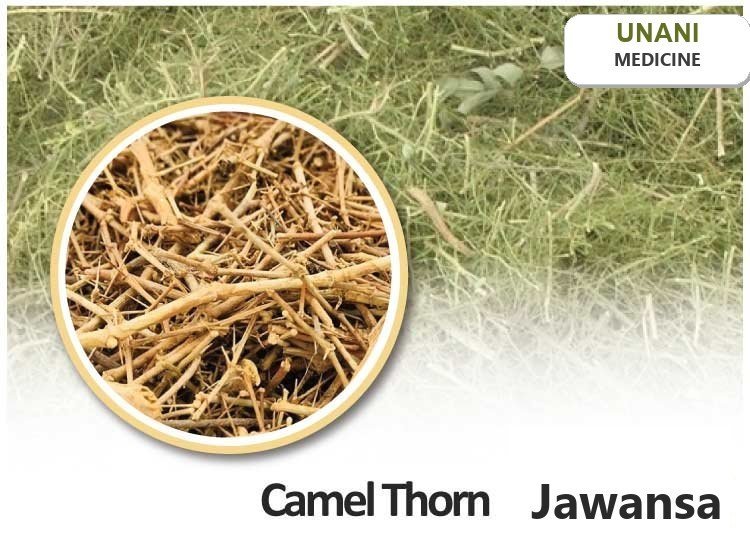
Camel Thorn (Jawansa)
Jawansa (Fagonia arabica) (camel thorn) is a hot, dry thorny plant used as a diuretic and blood purifier, with traditional remedies for piles, stones, pimples, joint pain and mouth ulcers.
Other Names
Well known as Jawansa (Hindi, Gujarati: Jawansa; Punjabi: Jawanha; Sindhi: Kandero; Bengali: Yuvasa; Persian: Khar-e-Shutar; Marathi: Kante Chabak; Arabic: Haj; Sanskrit: Yasa). Latin: Fagonia arabica. In English it is called Camel Thorn.
Identification
It is a thorny plant about one metre tall. Its shape is similar to Dhamasa, but its leaves and thorns are larger than those of Dhamasa. Its leaves are like henna leaves but somewhat smaller. It spreads in the heat but dries up in the rainy season. Camels eat this herb very eagerly. It grows abundantly in land near water. The colour is green and the taste bitter.
Temperament (Mizaj)
Hot and dry.
Dosage
3 grams to 5 grams.
Benefits
It is a diuretic and a powerful blood purifier. Sitting in its decoction up to the waist gives immediate relief in piles, both windy and bleeding. Taking it ground up removes the poison of mercury. Drinking its decoction mixed with pure ghee relieves swelling.
Taranjabin, mentioned in the previous chapter, is the congealed exudate of this same plant. Jawansa and Dhamasa are two separate plants. An illustrated description of Dhamasa has already appeared earlier in this book; please see it there (Hari Chand Multani).
Simple Tried Remedies of Jawansa
Pimples
Soak 5 grams of Jawansa in 25 grams of water, make a decoction and wash the face with it. The pimples will go away.
Kidney and bladder stones
Drinking 20 grams of the distilled extract (arq) of Jawansa two to three times a day breaks up and expels stones of the kidney and bladder. In summer, use it with a suitable syrup.
Film over the eye
Applying the juice of Jawansa to the eye with a light probe (salai) removes a minor film.
Joint pain
Burn 100 grams of Jawansa in 250 grams of sesame oil, strain, and massage with this oil. It is beneficial for joint pain and back pain.
Piles
Taking 5 grams of the squeezed juice of Jawansa twice a day brings relief in piles.
Mercury poisoning
If someone has swallowed mercury, giving 5 grams of Jawansa juice four times a day for four days continuously expels the raw mercury from the body.
Mouth ulcers
Gargling with a decoction of its leaves is beneficial for mouth ulcers and swelling.
Haemorrhoidal warts
The smoke of Jawansa leaves relieves the pain of warts, and a light external poultice of it removes haemorrhoidal warts.
Source: Encyclopedia of Herbs, by Hakeem Dr. Hari Chand Multani.
Jawansa: Further Description
English: Camel Thorn. Family: Papilionaceae.
Other Names
Arabic: Haj; Persian: Khar-e-Shutar; Bengali: Yuvasa; Punjabi: Jawanha; Gujarati: Jawaso; Sindhi: Kandero; English: Camel Thorn.
Description
The plant is thorny and one to two feet high. It stays green in summer. It has many branches, and its sharp thorns are up to one and three-quarter inches long. The leaves come out near the thorny bush; they are small, long, delicate and rounded. The flowers appear in spring, purple in colour, at the base of the thorns. The pod is about an inch and a quarter long, straight, somewhat crooked and knotty, filled with five or six tiny seeds. A tear-shaped gum exudes from the Jawansa plant, which is called Taranjabin; it is sweet like sugar candy but afterwards feels astringent. Nowadays the sweet Taranjabin found in the market is made from sugar or jaggery.
Habitat
This larger kind of Jawansa is scarce in India. It grows in Punjab, UP, Delhi and Rajasthan. It is found abundantly in Egypt (Syria), Kandahar (Afghanistan), Khorasan (Iran) and Arabia.
Special Note
Its appearance is similar to Dhamasa, and the actions and properties of both are alike, so Vaidyas and Hakeems regard them as one. In reality it is a variety of the same plant.
Temperament (Mizaj)
Hot and dry in the second degree.
Uses
It is a diuretic, blood purifier and sedative (analgesic). Giving 2 grams of the root of Jawansa as a decoction benefits infantile tympany (dabba atfal). Sitting in its decoction up to the waist is useful for relieving pain in bleeding and windy piles. Bathing with it and drinking it ground up removes the harm and pain caused by mercury. Drinking its decoction mixed with ghee removes swelling. Taranjabin is the congealed exudate of this tree.
Dosage
Three to five grams (masha).
Source: Taj al-Mufradat (research on Khawas al-Adwiya), by Dr. Hakeem Naseer Ahmad Tariq.
Leave a Reply