
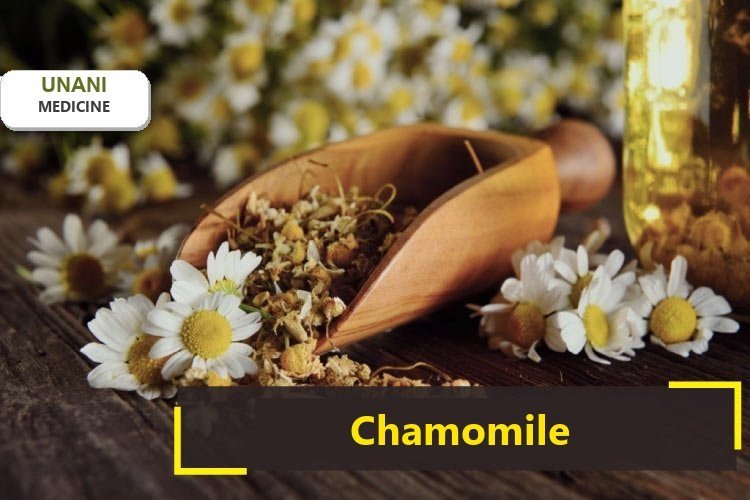
Chamomile (Babuna)
Buy Chamomile at Ajmal Dawakhana
Babuna (Matricaria chamomilla Linn.) (chamomile) is a fragrant flower used in Unani medicine for headache, eye and ear pain, joint pain, swellings and stones.
Other Names
Urdu: Babuna (babona); Arabic: Babunaj; Persian: Babunak; Hindi: Babuna; Unani formula: Malun; Sindhi: Babuno; English: Chamomile; Latin: Matricaria chamomilla Linn. It has countless benefits (chamomile benefits).
Identification
Under the name babuna (babona), its flowers are sold in the market; they are fragrant and white in colour. These are what is called “Phool Babuna” (chamomile flowers). The root of this plant is also used as a medicine under the name “Jar Babuna”. This herb grows by itself or is sown. Its leaves are small, fine and somewhat long, and the branches are green, delicate and thin. Its height is up to a hand’s length. It (babona) has many small branches. The flowers have single and double heads. The flowers of the single kind are yellow and white in colour. They are white, long and thin like a tube. The other kind of flowers is only white in colour. In both kinds of flowers the petals are arranged around the head. There is also a blue kind of flower, which physicians call Furfuri. This kind is rare but is the best of all.
The chamomile with yellow flowers is the mountain kind. Of these, the good one is that which is small and fragrant, with a fragrance like that of an apple. The chamomile with white flowers is of the larger kind. The fragrance of its flowers is not so strong and they are bland in taste. This kind of babuna (babona) is found mostly in Egypt. Chamomile is found in India and neighbouring countries.
Scientific Research
On chemical analysis the following constituents are found in it:
A volatile oil, salicylic acid, a glycoside called apigenin, and so on.
Temperament (Mizaj)
Hot and dry.
Dosage
One gram to three grams.
Benefits
Galen (Hakim Jalinus) and Dioscorides (Hakim Dioscoridus) were the first to experiment on it and found chamomile flowers (babona) very useful in malarial fevers. Easy tried remedies with chamomile (chamomile benefits) are as follows:
Headache
Make a paste of chamomile flowers (babona) in water and apply it on the forehead. It is useful (chamomile benefits) in headache caused by cold.
Eye Pain
For eye pain, straining its decoction and washing the eyes brings relief (chamomile benefits) to the pain.
Mouth Ulcers
If there are ulcers in the mouth, chewing chamomile (babona) brings benefit (chamomile benefits).
Injury
Foment the injured place with a decoction or poultice of chamomile flowers (babona), and relief will come. It is also useful (chamomile benefits) if a sprain occurs.
Earache
Soak 10 g of chamomile flowers (babona) in 100 g of water for 24 hours, then boil on the fire; when 25 g remains, burn this water off in 100 g of sesame oil, strain, and put three or four drops in the lukewarm ear. It is useful (chamomile benefits) for hardness of hearing and swelling of the ear.
Joint Pain
Grind chamomile flowers (babona) in water and apply as a poultice on the painful joint; relief will come (chamomile benefits).
Kidney and Bladder Stones
Soak 3 g of chamomile flowers (babona) in 50 g of water, boil, strain and use. It is useful (chamomile benefits) for breaking kidney and bladder stones.
Easy Tried Recipes with Chamomile (Babona)
Rub-e-Babuna
Take 35 g of chamomile flowers and soak them in two kilos of water for 6 hours, after which cook on the fire until half a kilo of water remains. Then strain it clean through cloth, mix in 12 g of finely ground sal ammoniac (naushadar) and cook until all the water has dried. It strengthens the stomach, liver and heart. It increases digestion. Dose: two grains to four grains dissolved in water.
Arq-e-Babuna
One part of chamomile flowers and 20 parts of water; soak in water for eight hours, then distil 10 parts of arq in the usual manner. It is useful for swellings of the body.
Dosage
Give 25 g twice a day.
Chamomile Oil (Tel-e-Babuna)
Take 300 g of fresh chamomile flowers, pound them, make cakes of them and fry them in one kilo of sesame oil. When they are close to burning, take them out and clean the oil. A lukewarm massage with this oil is very useful in joint pain and swelling. Soaking a cotton swab in this oil and placing it in the uterus is also useful for swelling of the uterus.
Another
Put 100 g of chamomile flowers and 400 g of sesame oil in a bottle and keep in the sun for 40 days. After that strain and use. A lukewarm massage with it is very useful in rheumatic pain, backache and joint pain.
Surma Babuna
Grind black antimony (surma) with chamomile flowers for a week at night, dry it and store it in a vial. This surma is useful for all eye diseases.
Majun Falasifa
It is useful (chamomile benefits) in joint pain, backache and frequent urination. It is also a successful treatment for weakness before and after marriage.
Chamomile root, dry ginger, black pepper, long pepper, cinnamon, amla, baheda rind, Indian Shitraj, wounded zarawand (Zarawand Mudahraj), Khusyat-ul-Tha’lab (salep orchid), pine nut kernels, 30 g of each; chamomile seeds 15 g; raisins (seeds removed) 90 g. Grind finely and make a confection (majun) by mixing in 3 times as much pure honey. Take 6 g with lukewarm milk. It is very useful (chamomile benefits) for cold-tempered people and the elderly.
Encyclopedia of Herbs, by Hakim and Dr. Hari Chand Multani
Babuna (Chamomile)
Family
Compositae.
In Latin
Matricaria chamomilla.
Other Names
In Arabic Babunaj, in Sindhi Babuno, in Hindi Murhi and in English Chamomile.
Description (Mahiyat)
The plant is about three feet high, with many tiny, green, soft branches which sometimes grow up to a span. The leaves are small, somewhat long and downy. The flowers are like the flower of the Siwati (a daisy-like flower), with whorled flowers having single or green heads, and the colour of the flowers is white or yellow. The white flowers are more fragrant and effective. The seeds are within the flowers. When drying the flowers, care should be taken that the fragrance and whiteness of the flowers are not reduced. The root and flowers of chamomile alone are used as medicine.
Kinds of Chamomile
There are several kinds, but four kinds of chamomile are used in medicine. In Persian books the term babuna applies only to Babuna Gau Chashm (ox-eye chamomile), whose botanical name is Matricaria chamomilla. Earlier physicians used it to bring on the menses. It is a many-branched herb; the leaves are fine, long and downy; the flowers are white but, from the middle, like an ox’s eye. (2) Babuna Rumi (Roman chamomile), (3) Babuna Hispani, that is, Aqarqarha (pellitory).
Place of Origin
Its plants grow in Pakistan, the plains of northern India and Europe.
Note
In Iraq, Babuna was the name of a village where it grew abundantly. Here the actions of Gul-e-Babuna (chamomile flower) will be described.
Temperament (Mizaj)
Hot in the second degree and dry in the first degree. Taste: unpleasant, bitter and sharp.
Actions (Af’al)
Strengthens the stomach, dispels wind (kasir-e-riyah), resolvent (muhallil), strengthens the brain and nerves, promotes urine and menses.
Uses
In medicine chamomile is mostly included in poultices (zimad) for resolving swellings and hardnesses; that is, it is generally used by washing with its decoction for fomenting injuries, sprains and swellings. In brain and nervous diseases, weakness of the stomach, windy pain, causing vomiting from the stomach, intermittent fevers, and for expulsion of phlegm from the chest, in jaundice, earache, sciatica, rheumatism and the like, it is given as a powder or in various ways, or massaged on.
To bring out the foetus and afterbirth and to promote urine and menses, the patient is seated in its decoction as a sitz bath (abzan) and it is also used internally.
Chamomile oil is made in sesame oil. It is useful for sprains, swellings and swelling and pain of the ear. The oil of the flowers relieves spasm. It softens the nerves and gives them strength. The root of chamomile is strong in all actions.
Special Benefit
Resolvent of swellings. Side effects: to the throat. Corrective (Muslih): pure honey. Substitute (Badal): Birinjasif (mugwort/Artemisia).
Chemical Constituents
A blue volatile oil, azulene; some glycosides, anthemene; anthemic acid, a sharp substance; tannins, resin; oil: angelic acid and anthemol and the like are found in its oil. Its fresh oil is light blue or greenish-blue and later becomes brownish-yellow.
Dosage
One to three grams (masha).
Well-Known Compounds
Roghan-e-Babuna, Jawarish Babuna, Majun Falasifa, Zimad Muhallil.
Important Point
Chamomile is also used in homeopathy. The medicine made from it, Chamomilla, is a well-known medicine for children. It is used for jaundice of the newborn, fretful children, the troubles of teething in children, and unbearable earache in children and adults. It is used in different potencies for these troubles. To learn its details, study the Materia Medica (Year One) of Professor Homeo Dr. Mian Naseer Ahmad Tariq.
Taj-ul-Mufradat (Research in Properties of Drugs), by Dr. Hakim Naseer Ahmad Tariq
Leave a Reply