
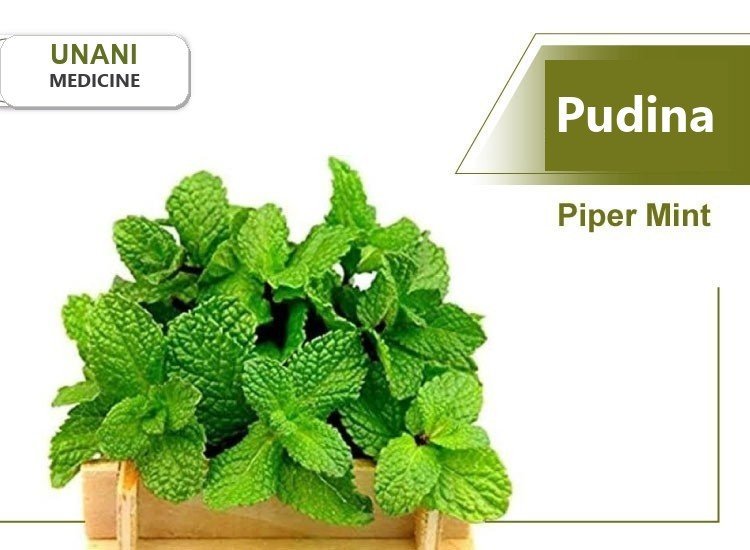
Peppermint (Pudina)
Pudina (Mentha spp.) (mint, peppermint) is a hot, dry aromatic herb used in Unani medicine mainly as a stomach tonic and digestive, for worms, nausea, delayed menstruation and in many tried compounds.
Other Names
Urdu: Pudina. Bengali and Punjabi: Padina. Sindhi: Phodino. Persian: Pudina. Hindi: Pudina, Padna. Sanskrit: Duchne. Latin: Mentha. English: Peppermint.
Mint has many varieties. Commonly used are Pudina, Filfili (peppermint) or Bustani (garden mint). This mint has a pleasant taste and a desirable fragrance, which is why it is added to spice mixes and chutneys. The colour of its leaves is blackish.
Identification
Its leaves are oval, somewhat hairy or almost smooth, with saw-like toothed edges. The flowers are purple and appear on the branches.
Temperament (Mizaj)
Hot and dry in the second degree.
Dosage
3 grams to 5 grams.
Benefits
For ear worms, dropping the lukewarm juice into the ear is useful. Chewing its leaves is useful for toothache. Using mint with figs as a decoction brings out phlegm of the chest and lungs. Using its distillate (arq) is useful for weakness of the heart. For stomach diseases mint has a strengthening effect. Giving mint with honey benefits intestinal worms.
For family planning, it is said that grinding its leaves and placing them as a pessary in the female private parts before intercourse prevents conception.
Tried Remedies of Pudina
Stomach pain
Dry mint 3 grams, sumac 10 grams, edible salt 5 grams, black pepper 8 grams. Pound and sieve all the drugs to make a powder. This powder is useful as a digestive and stomach tonic and for expelling stomach gas.
Dose
Give 3 grams with fresh water.
Sharbat Pudina
One part pomegranate juice squeezed from pomegranate seeds, 1/2 part fresh green mint, and sugar equal to both together. Mix everything and boil, skimming off the froth. When it reaches syrup consistency, take it off the fire and keep. This syrup is useful for weakness of the stomach and heat of the stomach.
Arq Pudina (mint distillate)
Take as many mint leaves as you like and distil with six times the water. Dose: 75 grams. It is a stomach tonic, digestive tonic and heart tonic.
A formula comparable to Amrit Dhara
Camphor one part, Sat Pudina (menthol) one part, Sat Ajwain (thymol) 1/2 part. Put the three drugs in a vial and keep in the sun. After a short while the medicine becomes like water.
Externally it is useful for headache, nerve pain, toothache, muscle pain, back pain and sprains.
Internally it is useful for stomach pain, upset stomach, stomach gas, indigestion, diarrhoea, cholera, plague and the like. Give it mixed in batasha or misri three or four times a day.
Apply it externally on the painful spot. For back pain and the like, rub it mixed with rose oil or similar.
Hiccups
One rice grain of Sat Pudina mixed with ten grams of sugar; give it to eat. The hiccups will stop.
Remedy for bloating
Dry ginger 5 grams, aniseed 10 grams, dry mint 10 grams, black salt 10 grams, white cumin 10 grams, fennel 10 grams, Lahori salt 30 grams.
Make a powder of all and keep. After meals take 3 grams to 5 grams with fresh water.
Bal Sharbat Multani (children’s syrup)
Sat Pudina and camphor, put in a vial, close with a cork and keep in the sun for a few minutes. Its name is “Arq Chamatkar”.
First take half a bottle of clear lime water, 200 grams of fennel distillate, 200 grams of borage distillate, 400 grams of white sugar, and 40 drops of Arq Chamatkar.
Method
First dissolve unslaked lime in one kilo of clean water and keep it soaked for three days. Stir it three times a day. Afterwards clarify, strain and fill into a bottle. Take half a bottle of lime water, mix in all the distillates and white sugar and prepare a syrup. When it cools, strain it, add the Arq Chamatkar, mix very well, fill into vials and pack. It is useful and tried, and a routine remedy of the clinic.
Use as needed for all children’s diseases, green and yellow stools and every kind of weakness.
Dose
Up to six months of age, 5 drops; up to one year, 10 drops; for a two-year-old child, half a spoonful, with fennel distillate or mother’s milk. It is many times better than market gripe water.
Modern Allopathic Preparations Made with Mint
Barqi
Carbolic acid 5 grams, chloral hydrate 5 grams, creosote 5 grams, tincture of iodine 5 grams, camphor 5 grams, menthol (Sat Pudina) 5 grams, Roomi mastic 5 grams, clove oil 5 grams.
Method of preparation
Put everything in a vial, close with a firm cork and keep. “Barqi” is ready. As its name, so its action: it acts like lightning. When needed, apply it with cotton on the aching tooth. Relief will come immediately.
Another
Chloral hydrate, camphor and menthol, 5 grams each. Put in a vial and keep in the sun. When it becomes like water, apply it with a cotton swab into the hole of the tooth. It is extremely useful for toothache and works immediately.
Another
Chloral hydrate 1/2 dram, camphor 1/2 dram, menthol 1/2 dram, spirit of chloroform 1/2 ounce, tincture of myrrh 1/2 ounce, clove oil 1/4 dram, creosote 5 drops. Mix everything and apply with cotton swab to the aching tooth.
Mendel’s Paint
Potassium iodide 5 grains, iodine 5 grains, oil of peppermint 5 drops, glycerine one ounce. Rub all the ingredients in a mortar, mix in the glycerine and keep in a vial. Apply a light amount of the medicine to the throat with a cotton swab. It is useful for removing even severe throat inflammation and swelling.
Source: Encyclopedia of Herbs, by Hakeem Dr. Hari Chand Multani.
Pudina (Mint): Further Description
Latin
Mentha arvensis. Family: Labiatae.
Other Names
Arabic: Fudanj, Futanj. Sindhi: Phodino. English: Mint.
Description
It is a famous aromatic herb, similar to basil (tulsi). It has many varieties, for example one wild and one garden, and these in turn have several kinds.
Pudina Roomi or wild mint (Mentha viridis)
This vine-like herb is fragrant. The leaves are soft, dark in colour, with toothed edges and lines on them. The leaves are round, long and pointed, and the flowers are small, light blue and spear-shaped; spikes appear in clusters, containing seeds. Remember that its branches are buried in the ground, from which roots emerge and the plant spreads again. It is generally planted in gardens. It flowers in June and July.
Habitat
Besides Pakistan and India, it is also sown in some places in Europe.
Pudina Filfili (Mentha piperita)
Its stem is at first upright. The branches are opposite each other, the leaves oval and somewhat hairy, the flowers purple, the fragrance strong, and the taste hot, pungent and bitter like black pepper. After eating, the mouth feels cool like camphor. That is why it is called peppermint in English.
Chemical constituents
A volatile oil, tannin and gum are found.
Pudina Barri (Mentha sylvestris)
This grows in open and damp lands in Europe and Asia. It flowers in July and August.
Pudina Nahri (Mentha aquatica)
It generally grows wild on the edges of water, streams and canals in Pakistan and India, abundantly in July and August.
Temperament (Mizaj)
Hot and dry in the second degree.
Actions
Opener of thick matter (munfij), resolvent, attenuant, absorbent, skin-reddening, killer of intestinal worms, sedative of pain, diuretic and emmenagogue, sudorific, carminative (expels gas) and stomach tonic; it also has antidote properties.
Uses
Mint is mostly used in stomach diseases such as weakness of the stomach, abdominal pain, flatulence and loss of appetite. A decoction or distillate of it is given to soothe vomiting and nausea. Giving mint water to drink and as an enema kills intestinal worms. Worms of the nose and ear also die with its water. It is a very strong drug for promoting menstruation. For this reason, using it as a pessary during pregnancy causes miscarriage. It attenuates phlegm and expels it. Being a sudorific, it is useful for jaundice. It thins morbid matter and expels it through the pores (towards the skin). Applied as a poultice with wine, it removes dark discoloration of the skin. Applying it on the site of a scorpion or wasp sting absorbs the poison and soothes pain.
A decoction of mint leaves, taken morning and evening, even four or five times a day, for four days before the menstrual days, makes menstruation come freely.
Famous Compounds
Jawarish Pudina, Jawarish Anarain, Arq Ajeeb, Arq Pudina.
Majun Futanji
It is useful for dissolving clotted blood (whether the clotting is in the bladder or the stomach) and for relieving pain of the stomach and liver. It is also used and useful in phlegmatic and chronic fevers.
Safuf Islah-e-Meda, whose basic ingredients are mint and senna, is described as an unmatched tried remedy for stomach diseases and constipation.
Personal Experience
Sometimes I wash mint leaves with water and eat them with bread. This keeps the stomach and liver in order. It creates a good appetite. It is a mild laxative. Dose: fifteen to twenty leaves.
Sat Pudina (Peppermint, menthol)
Description
These are fine crystals obtained chemically or by distilling peppermint (Pudina Filfili). They are colourless, slightly yellowish, and take the form of an oil in great heat or sun. The smell is strong, and the taste is strong and aromatic.
Temperament (Mizaj)
Hot and dry in the first degree.
Uses
A stomach tonic and carminative; useful in abdominal pain and heart pain (waja al-fuad), and in swelling and ulcer of the stomach. It reduces swelling as well as fevers. It is used and useful in cholera and the said diseases, alone or with camphor and Sat Ajwain.
Dosage
One to three drops (usual practice).
Famous compounds
Amrit Dhara, Payam-e-Sehat, Safuf Hazim.
Arq Pudina
Uses
It stops nausea and vomiting and corrects the function of digestion. It is a stomach tonic and carminative, and is useful in chronic fever.
Dosage
Drink a cup of the distillate in the morning on an empty stomach; in severe illness it can also be used two or three times a day.
Pudina Kohi (Mushk Tramshi)
English
Pennyroyal / Savin.
Latin
Ziziphora tenuior / Mentha pulegium. Family: Labiatae (tulsi).
Other names
Arabic: Mushk Tramshi. Persian: Pudina Kohi. Sindhi: Phodino Jabali.
Description
This is a variety of mint. Its plant is two or two and a half feet tall. The flowers are very small, or fine and hairy. The leaves are small, somewhat round and almost pointless. Colour: green, somewhat whitish. Taste: sharp and pungent.
Temperament (Mizaj)
Hot and dry in the third degree.
Actions
Carminative, diuretic and emmenagogue, and killer of intestinal worms.
Uses
It is mostly used to promote menstruation, to expel the foetus and afterbirth, and to promote urine. A powder or decoction is given to kill intestinal worms. It is useful for the stomach, liver and spleen. It relieves colic (colic pain).
Note
Its use is like that of mint, and the benefits are the same.
Chemical constituents
A volatile fine oil and a principle named pulegone are found. Besides medicinal purposes, the said oil is used in scenting soap and in making synthetic mint essence (menthol).
Dosage
Five to seven grams (masha).
Famous compound
Matbookh Mudir-e-Tams (menstrual promoter).
Note
If it is kept in a room, fleas run away from its smell.
Source: Taj al-Mufradat (research on Khawas al-Adwiya), by Dr. Hakeem Naseer Ahmad Tariq.
Leave a Reply