
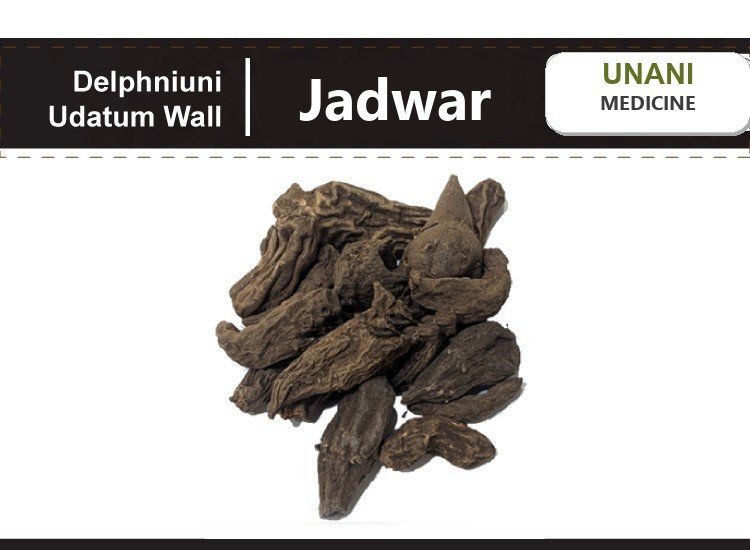
Larkspur (Jadwar)
Jadwar (Delphinium denudatum) (Nirbisi, Delphinium): Unani antidote to poisons and tonic for the heart and nerves, with varieties, identification, temperament, dosage and traditional formulas.
Other Names
In various languages it is called Jadwar, Mah Parveen and Nirbisi. In English it is called Delphinium (an antidote, “tiryaq”).
Identification
It is the root of a herb of conical (sanobari) shape, similar to bachhnag (aconite). It is heavy, somewhat hard and bitter in taste. The color is ash-gray on the outside and violet on the inside. A root is sold in the market under the name Jadwar. It is black, and when broken it is violet inside. It is found growing together with the plants of mitha telia (aconite), which is a poison, and this is its antidote.
Warning
Nowadays dried black carrots are also sold as Jadwar. The main way to recognize them is that, compared with Jadwar, they are much lighter and much softer than the hardness of Jadwar.
Varieties
There are several kinds, but the well-known ones are these.
- Black on the outside, violet with a reddish tinge inside, conical in shape. Slightly sweet in taste but very bitter afterward. This kind is called Jadwar Khatai and is the one most often used.
- Blackish-yellow inside and out, bitter in temperament, shaped like a scorpion. This is the next best kind after Jadwar Khatai. It is found in Nepal and Tibet.
- Black inside and out, gives a blue color when ground, and has a bitter taste. In quality it is inferior to the other two. This too comes from Nepal and Tibet.
Note
Because Jadwar resembles bish (mitha telia, aconite), there is much possibility of confusion between them. They can be distinguished by these points: bish is often smaller than Jadwar. If bish is cut and placed on the tongue, burning and numbness are felt. If Jadwar is licked afterward, it is relieved. Thus its antidotal quality is proved.
Dosage
Half a gram to one gram.
Temperament (Mizaj)
Hot and dry in the third degree.
Benefits
It is an antidote to poisons, mufarrih (exhilarant), tonic for the vital organs, tonic for the nerves, and useful for weakness. It removes pain and is a remedy for phlegmatic and black-bilious fever. Because it is an antidote to poisons it is used for most poisons: it is ground and given to drink, and also ground and applied on the poisoned place. It is the special treatment for bachhnag poison. For one who has eaten mitha telia, after inducing vomiting, Jadwar is ground in milk and given to drink. For snake bite and scorpion sting, it is ground in wine and given. Being a tonic for the nerves and vital organs and a mufarrih, it is a good protective medicine against epidemic diseases. Used in plague and cholera it removes the disease, and it helps to maintain the strength of the vital organs. Because it removes pain, it is used to soothe external and internal pains. Thus it benefits when massaged on external pains, and when about half a gram is given with suitable medicines in pains of the internal organs.
Being a resolvent and opener (munfij), applying it as a poultice on all kinds of swellings dissolves them or bursts them.
Being a jali (cleanser), it removes leucoderma (phulbehri), white patches and other marks on the face. Because Jadwar is munfij, mulattif (rarefying) and a nerve tonic, it is useful for catarrh and cold, epilepsy (mirgi), paralysis, facial palsy (laqwa), flaccidity (istirkha), tremor, numbness (hazar), and besides these for weak stomach, liver obstruction, dropsy and colic pain. It also benefits jaundice, and in it the action of Jadwar is even more useful. By the above actions it is used in brain diseases of children and in the disease of sookha (wasting). Because it is diuretic, it is used in difficulty in urination and also benefits jaundice.
Pills of Jadwar are made, which are used in catarrh and cold, other brain diseases, weakness before and after marriage, and phlegmatic diseases.
Easy Medicinal Formulas of Jadwar
Medicine for Plague
It is extremely useful for plague. Take Jadwar banafshi, zahr mohra and tabasheer, two grams each, and camphor one gram; rub them down in arq bed mushk as needed and give every hour.
Another
Jadwar banafshi 6 grams, camphor 10 grams, doronj aqrabi 10 grams; grind well in a suitable amount of rose water and make pills the size of a chickpea. In an epidemic period, if healthy persons eat two pills daily as a precaution, they remain safe from attack of the disease.
Scrofula (Khanazir)
In scrofula, grind Jadwar in coriander water and apply externally, and give half a gram of powder in honey.
Facial Palsy (Laqwa)
Give half a gram of Jadwar in one spoon of honey morning and evening. It is useful for facial palsy, a limb being struck (paralysis), and brain attacks.
Treatment of Toxic Effects
Jadwar is also a successful treatment to remove the toxic effects of modern medicines. Keep giving it in a quantity of half a gram in honey.
Habb Jadwar
These pills stop cough and catarrh. They are also useful for jarayan (involuntary seminal discharge) and premature ejaculation. They are also a tested remedy to break the habit of opium (afyun). White pepper, cinnamon and pipli, two grams each; cloves 3 grams; Jadwar, nutmeg, saffron, kababa, mastic and khusyat-us-sa’lab, 5 grams each; opium 10 grams. Pound and sieve, and with gum water make pills the size of a small chickpea. Give one to three pills at bedtime with milk.
Note: Do not give this medicine continuously to nursing mothers, because the effect of opium reaches the child through the mother’s milk. (Hari Chand Multani)
Marham Jadwar (Jadwar Ointment)
It fills wounds and removes glands (lumps). It is very useful for the buboes of plague.
Jadwar 4.5 grams, gandha biroza 18 grams, turmeric, deodar, licorice, henna leaves, smoke from the roof of a bhar bhunja (grain parcher), 36 grams each; bark of the kikar tree, neem leaves, ratan jot, 65 grams each.
Except for the biroza, make a fine powder of all the medicines and boil them in 2.5 kg of water until two thirds remain; then strain, add 720 grams of sesame oil and cook again. When the water has burned off and only the oil remains, add the biroza, add 60 grams of wax, and cook to make an ointment. Warm it slightly and apply on the glands. Over it, warmed flannel or cotton should be tied on. (Hakim Syed Muhammad Iqbal Zaidi)
Encyclopedia of Herbs by Hakim and Dr. Hari Chand Multani
Nirbisi “Jadwar”, Mah Parveen
Latin: Delphinium.
Other Names
In Arabic Jadwar, in Persian Mah Parveen, in Pashto Zahr Booti, in Nepali Nilo Bakh, in Hindi Nirbisi, in Latin Delphinium.
Description
The plant is up to six feet tall. The stem is smooth or sometimes has fine hairs on it. The leaves are round, two to six inches long, green above and yellow below, marked with spots like sesame. They are divided into several parts like coriander leaves. The leaf stalks are long. The flowers are one to one and a half inches long, round and elongated, with the lower petals deep blue or ash-gray in color. The petals of the flower are blue. On the right and left side, below each flower, there is a projection in the form of an elongated bud. On the inner petals of the flowers there is fine hair on both sides. The roots are conical, knotty, as long as a finger, heavy, sweet then bitter, black or brown on the outside and bluish inside.
Recognizing the Pure Drug
If it is rubbed in water and the water turns blue and tastes bitter, it is good and superior Jadwar.
Varieties
(1) That which grows in the mountains of Khata is the best. (2) Black-yellow inside and out, bitter in taste and scorpion-shaped. (3) Black inside and out, and when ground in water the water turns blue; the taste is bitter. In quality it is next after the second kind. (4) Blackish and bitter, about the size of an olive fruit. (5) Jadwar Andalusi (antla): black and soft, extremely bitter and about a span long.
Habitat
Kashmir, Himalaya, Nepal, Tibet, Deccan, Andalusia, Khurasan and so on.
Temperament (Mizaj)
Hot and dry in the third degree.
Actions
Antidote to poisons, mufarrih, tonic for the vital organs, nerve tonic, opener (muftih), resolvent, mulattif, concoctive (munzij), aphrodisiac, diuretic, lithotriptic (muftit-e-hisat), analgesic, jali, remedy for phlegmatic and black-bilious fever.
External Use
It benefits when applied on external pains and when half a masha is given with suitable medicines in pains of the internal organs. Because it is a resolvent and concoctive, it is used as a poultice in all kinds of swellings. Thus when applied on swellings of the groin, plague, scrofula, diphtheria (khunaq) and other kinds of swellings and pustules, it either dissolves them or ripens and breaks them. Because it is a jali, applying it removes white bahaq, leucoderma, freckles and other marks on the face.
Because it is an antidote to poisons, it is given and applied in all kinds of hot and cold poisons. As an antidote it is ground and given to drink, for example in snake and scorpion bites it is given to drink mixed with wine and ground and applied on the bitten place. It has a special effect with bachhnag; thus, after inducing vomiting in one who has eaten bish, it is useful to give Jadwar ground in milk.
Internal Use
Because it is antidotal, a tonic for the vital organs and a mufarrih, it is a good protective medicine in epidemic diseases; therefore, used in plague and cholera it removes the disease. It helps in maintaining the strength of the vital organs. Because it soothes pain, it is used (half a masha) to relieve external and internal pains.
Jadwar is an opener, mulattif and nerve tonic, so it is useful for phlegmatic brain diseases such as catarrh and cold, epilepsy, paralysis, facial palsy, flaccidity, tremor and numbness, besides weak stomach, liver obstruction, mesenteric obstruction, dropsy and colic. It is used in brain diseases of children, especially Umm-us-Sibyan (convulsions of children).
Jadwar also has a diuretic action. Therefore it is used in difficulty in urination, and it benefits jaundice. Being diuretic and lithotriptic, it is useful in kidney and bladder stones. Being an aphrodisiac and nerve tonic, it is used in many ma’ajeen (confections) and medicines for sexual power. It is a useful medicine for catarrh and descent of water in the eyes.
Modern Research
With this medicine the movement of the heart becomes slow and strong, and with the heart movements becoming regular and strong, the circulation of the blood becomes correct, by which all organs and faculties can perform their functions better.
Special Benefit
Antidote to poisons; mufarrih and cardiac tonic.
Side Effects
For people of hot temperament.
Corrective (Muslih)
Fresh milk, barley water (ma-ush-sha’ir).
Substitute (Badal)
Zarnabad, Taryaq Farooq.
Chemical Constituents
It contains delphinine and staphisagrine (a dokhar-type alkaloid).
Dosage
Half a gram to one gram.
Well-Known Compounds
Habb Jadwar, Khamira Gaozaban Jadwar Ood Saleeb Wala, Zimad Warm Lozatain, Marham Jadwar and others.
Source: Taj-ul-Mufradat (Research) Khawas-ul-Adwiya, by Dr. and Hakim Naseer Ahmad Tariq.
Leave a Reply