
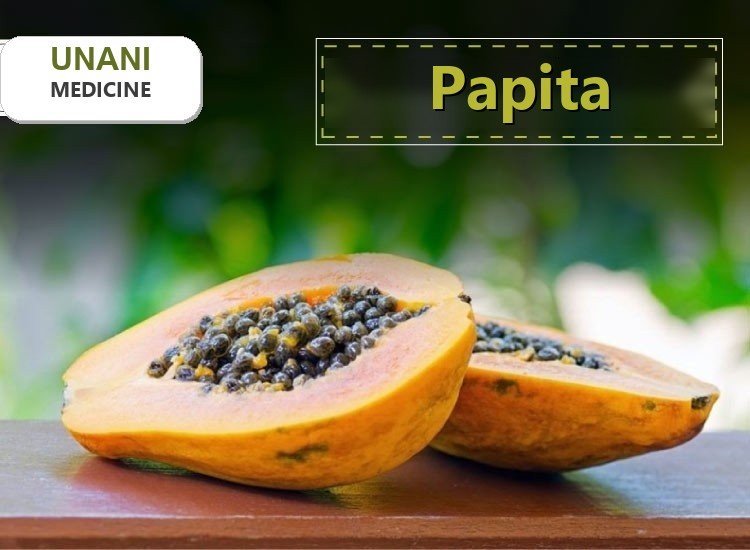
Papaya (Papita)
Papita (Carica papaya) (Papaya), called Arand Kharbooza in Unani medicine, is a cold, moist fruit that aids digestion, relieves constipation and piles and helps expel intestinal worms.
Other Names
Called Arand Kharbooza (papita) or Arand Kakri in Urdu; Shajar-ul-Batikh in Arabic; Kath Gadra in Gujarati and Sindhi; and Papaya in English. (Another source: Arand Kharbooza or Arand Kakri in Urdu and Punjabi; Bedanjeer in Persian; Papai in Gujarati; Kath Kadra in Sindhi.)
Habitat
It is a native tree of America, but is now found throughout India, neighboring countries and other hot countries, where it thrives.
Identification
The papaya is a small tree with a soft trunk, containing a milk-like sap, with thin and coarse bark. At the top of the trunk a cluster of large smooth leaves emerges. The leaf stalks are very long. The flowers are light yellow and fragrant. The fruit contains a good quantity of seeds, fewer in some and more in others.
In more detail: Arand Kharbooza is the fruit of a tree, like a melon but smaller. In the raw state its color is green outside, with white flesh and milk inside. When ripe, the skin becomes yellow and the flesh red, tasting more or less sweet (rather insipid). Its seeds are small, round, brown or black. The tree resembles the castor (arand) tree, and the leaves look like castor leaves. Male and female flowers are on separate trees; the male flowers are in long hanging clusters and the female flowers in small clusters.
Temperament (Mizaj)
Cold and moist. (Another source: the ripe fruit is hot and moist, and the raw fruit is hot and dry.)
Dosage
60 to 80 grams. (Another source: five or six tola, 50 to 60 grams, but it is better to give according to tolerance and temperament on the advice of a hakim.)
Actions
Digestive (hazim), appetizer (mushtahi), wind-breaking (kasir-e-riyah), diuretic (mudirr-e-bol), stone-breaking (mufattit-e-hisat), and killer of intestinal worms, especially the milk of the papaya.
Benefits
Ripe papaya is eaten as a fruit. Vitamins A, B, C and D in it are of great importance. It is useful for inflammation of the heart and stomach, piles caused by heat and bleeding from the mouth. Applying its milk on ringworm is useful. It benefits poisonous diseases and corruption of blood. Its pickle removes swelling of the spleen. It is useful for the liver. It is harmful for people of cold, phlegmatic temperament.
Its juice removes spots, marks and pimples on the face. Applied on burnt areas, it reduces burning and pain. It is extremely useful for heart diseases. The ripe fruit is a blood purifier, stomach tonic and digestive. It is given for piles and enlarged liver. Its daily use is useful for removing chronic constipation. A decoction made by boiling the leaves is given to horses as a purgative.
It is very useful for patients with high blood pressure; using papaya keeps high blood pressure under control. It is also a tried remedy for chronic constipation and indigestion. In jaundice, liver disorders and enlarged spleen, its use is beneficial. Eating raw papaya as a vegetable increases the milk of nursing mothers.
Eating papaya strengthens the stomach, creates a good appetite and expels gas. It promotes urination and breaks stones. Intestinal worms, especially roundworms and pumpkin-seed-like tapeworms, are killed by its use and expelled. Applying the milk that comes from raw papaya relieves pain. Soaking cloth in it and using it as a vaginal pessary induces menstruation and abortion. This milk is an irritant, so applying it for ringworm and scorpion stings is useful. The raw fruit is also used to tenderize tough meat quickly.
Special Benefit
The seeds of papaya have a worm-killing effect. They are given with honey to expel intestinal worms (roundworms). A decoction of boiled papaya leaves is given to horses as a purgative. It helps digest food.
Side Effects
It increases heat in people of hot temperament (mahroorin). It should not be used by pregnant women.
Modern Research
Papaya contains 89.6 percent water, 9.5 percent carbohydrate, 0.5 percent protein, 0.1 percent ether extract, 0.4 percent mineral salts, 0.1 percent calcium, 0.01 percent phosphorus and 0.4 percent iron. In addition it contains gallic, tartaric and citric acids and their salts. In every 50 grams of papaya, a constituent called papain increases strength and boosts digestive power. Papaya is rich in vitamins A and C, owing to which a person who eats the fruit is protected from asthma, tuberculosis, eye diseases, anemia, liver diseases and bone troubles.
Home Remedies and Formulas
Intestinal Worms
It has a deadly effect on round intestinal worms (kharateen), though it is not useful for killing tapeworms or pumpkin-seed worms. For an adult patient, one big spoon each of fresh juice and honey is mixed in lukewarm water and given. Three hours later a purgative of castor oil is given.
Ringworm and Eczema
Mixing its seeds with glycerin and applying on ringworm and eczema brings complete relief.
Swelling
Making a poultice of its leaves and binding it on a swelling dissolves the swelling.
Scanty Menses
Feeding the raw fruit to a woman for three or four days continuously removes the complaint of scanty menses. However, its use is strictly forbidden for pregnant women, as there is a danger of miscarriage. Its root, too, is a white root, but pregnant women should avoid it also, as it too causes miscarriage.
Low Milk
For women with deficient milk, its leaves should be warmed and bound on the breasts. This increases the milk. Drinking the broth of the raw fruit also increases milk in women.
Spleen and Jaundice
Continuous use of ripe papaya removes both of these diseases. By its continuous use, piles also find relief.
Acne
Rub the pulp of ripe papaya on facial acne and wash with lukewarm water after a while; within a few days the acne disappears. Nursing mothers who continuously use papaya find an increase in milk.
Remedy for Aging
Papaya enters the fine pores of muscle fibers and helps the body dissolve diseased or hardened fibers or their parts, and proves helpful in removing toxic effects. Old age is the result of the hardening of blood-carrying vessels. There is a saying: "You are as old as your blood vessels are hard." Experts who know the human body accept this truth. If we could find a way to keep soft the tissues that cover the blood vessels and to break up the layers of disease germs, we should consider that we have found a sure way to conquer old age. Through this we could bring renewed vigor to the elderly, and relieve those who are weighed down by premature old age due to an unnatural life. For this, papaya has gained great popularity in making human life more joyful.
According to research by experts on the human body, many wonders of papaya can be counted, but it is sad that it has not yet found its proper place among the public, even though it has proved to be a successful remedy for driving away old age.
Sources
Encyclopedia of Herbs by Hakim and Dr. Hari Chand Multani; Taj-ul-Mufradat (Research on Khawas-ul-Adwiya) by Dr. and Hakim Naseer Ahmad Tariq.
Leave a Reply