
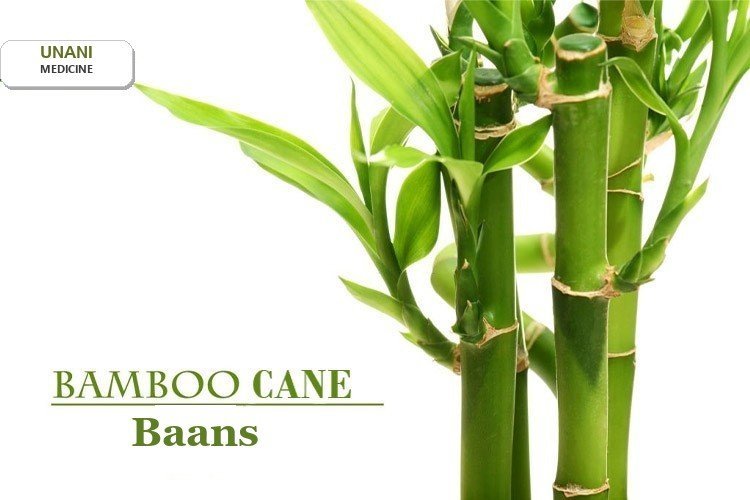
Bamboo (Baans)
Baans (Bambusa vulgaris) (bamboo) is a dry, cooling plant whose roots, shoots and leaves are used to remove pox scars, open suppressed menses, ease phlegmatic cough and strengthen teeth.
Other Names
Bans in Urdu and Hindi; Vans in Bengali; Vansh in Sanskrit; Velu in Marathi; Vans in Gujarati; Mangal in Tamil; Nay in Persian; Qasab in Arabic; Bamboo Cane in English; and Bambusa vulgaris in Latin. (Another source: Yunus in Sindhi, Bansh in Gujarati.)
Identification
Bamboo is of several kinds, for example: dried (mujaffaf), undried, Ismat, jungle-growing (ajami) and non-jungle (ghair ajami). The dried type is considered the best of all. Bamboo grows mostly beside water in watery land, that is, in damp places. Its joints are tall and its nodes are far apart. It is also called Nay Achi, because it comes from the island of Achi (Aceh). Writing is done with its pen.
Every kind of bamboo is hard, lustrous, of good color, reddish-black or somewhat whitish, free of fibers and straight. Any that is crooked is straightened afterwards. Then it is tied in bundles and sent to the market for sale. Useless bamboo is used as firewood.
Bamboo comes in two kinds, hollow and solid. It grows abundantly in forests and mountains. The leaves are three or four finger-widths long and one finger-width wide. Sometimes bamboo also bears fruit. First small white flowers appear, and from them come grains of rice called bamboo barley. Poor people use them as food. When hollow bamboos are split open, banslochan (tabasheer) comes out from the middle. This banslochan is the real tabasheer.
The color of bamboo is green when fresh and reddish-white-brownish when dry. The taste is bland with a slight bitterness. It grows commonly in the hill areas of Kangra and Hoshiarpur and on the islands of India and neighboring countries.
Temperament (Mizaj)
Dry and moist. (Another source: cold and dry in the first degree; burnt, hot and dry in the first degree.)
Description (Mahiyat)
It is a well-known tall plant, and bamboo is of several kinds. Color: green when fresh, whitish brown when dry. Taste: bland, slightly bitter.
Habitat
It grows abundantly east of the river Ravi in Kangra, Hoshiarpur and the forests, but mostly on riverbanks and in wet land.
Benefits
Because bamboo is muscular and nervine, it reduces excess moistures and raises blood pressure. A decoction of its shoots or root opens blocked menses. For hives that break out at night, giving the decoction to drink and bathing in it brings relief in a few days. Its root is slightly irritant, so the root powder is an excellent thing for removing smallpox scars. Mixed with honey as a linctus (looq), it is useful in phlegmatic cough.
Since it is a retainer of moistures (habis-e-rutubat), for people whose teeth have become loose from moisture and fibrous matter, or ache from excess moisture, using the ash of its burnt root as a tooth powder strengthens the teeth and stops the pain. Being extremely cold, it is also useful in spitting of blood (nafth-ud-dam). A poultice of bamboo blossom applied to a scorpion sting removes the poison.
Uses
The root of bamboo, alone or with suitable medicines, is used to erase smallpox scars and to brighten the complexion of the face. Because the root is porous, it is burnt and applied with jasmine oil to baldness patches and ringworm. Besides baldness, it is also applied to erase smallpox scars. The juice of the leaves with honey is useful for cough. A decoction of the shoots or root is given in scanty menses and lochia. The tender shoots make a good pickle. Boiling bamboo leaves in water and bathing a patient with it helps raktapitta, red rashes that suddenly break out on the body and itch badly; in my opinion this is the condition known as lakar kakra.
The root is added to tooth powders and rubbed on the teeth; the same root is also included in prescriptions that promote menstruation.
Special Benefit
Diuretic.
Side Effects
Harmful for the lungs.
Corrective (Muslih)
Tragacanth (katira) and mighz-e-khandaq.
Substitute (Badal)
Root of senthe (reed).
Dosage
Seven masha to one tola (7 to 10 grams).
Sources
Encyclopedia of Herbs by Hakim and Dr. Hari Chand Multani; Taj-ul-Mufradat (Research on Khawas-ul-Adwiya) by Dr. and Hakim Naseer Ahmad Tariq.
Leave a Reply