
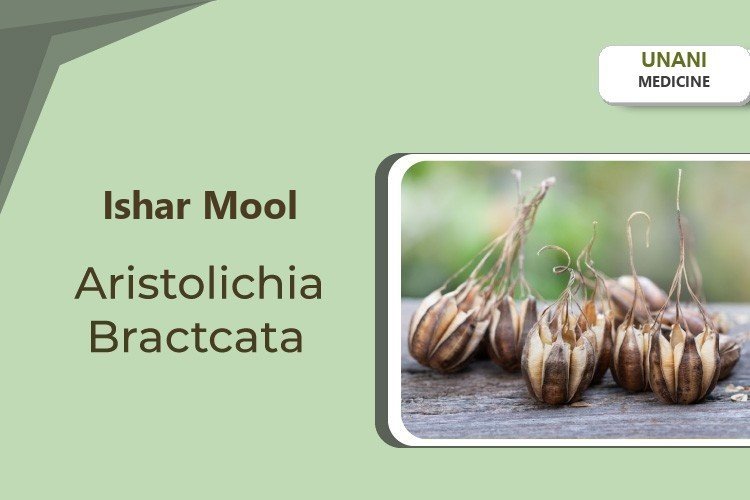
Indian Birthwort (Ishar Mool)
Ishar Mool (Aristolochia indica (A. bracteata)) (Indian Birthwort) is a bitter herb traditionally used for urine and menstrual retention and, in folk practice, against snake venom. The article covers identification, dosage and uses.
Habitat
This plant is commonly found in the low lands of Bengal, Goa, and Travancore in the south of the Deccan. It is also found in Nepal and Sri Lanka.
Other Names
Hindi: Ishar Mool. Famous name: Zarawand Mudahraj. Arabic and Persian: Zarawand Gird (Zarawand Mudahraj). Marathi: Sapsan. Gujarati: Ark Mool, Nol Bel. Bengali: Ishar Mool. Telugu: Gobal. Latin: Aristolochia indica. English: Aristolochia bracteata (as given in the source).
Identification
This is a shrub-like plant whose twigs lie twisting along the ground. Its leaves are of various kinds and the flowers are small and round.
The seeds of Ishar Mool are somewhat round and flat. The roots of Ishar Mool found in Bengal, Goa and Travancore are fragrant and bitter. Its taste is bitter.
In Unani medicine the large one is called Zarawand Daraz (long birthwort) and the small one Zarawand Mudahraj (round birthwort). The effect of both is about equal. The colour is yellow outside and reddish inside. Unani hakims use this medicine to bring urine and for suppression of menses.
Temperament (Mizaj)
Hot and dry.
Dosage
3 grams to 5 grams.
Benefits
It is useful for retention of urine and suppression of menses. For this reason its use is strictly forbidden for pregnant women, because it causes abortion. It is useful for removing phlegm, opening obstructions of the abdomen and expelling stomach worms. Snakes run away from the smell of Ishar Mool. This herb has been used since ancient times to remove snake venom.
Several doctors in foreign countries have also used Ishar Mool in their practice to remove snake venom and found it useful. Their experience is that if three leaves of Ishar Mool are rubbed well with ten black peppercorns and put with a little water into the mouth of an unconscious snakebite patient, and after ten minutes he is held and made to stand, the patient regains consciousness.
Dr. Pons writes in his work about this herb that among all the herbs in the world there is no herb that has proved as great an antidote in the treatment of snakebite as Ishar Mool. Ishar Mool is an unmatched herb for removing snake venom, which has been within people’s experience since ancient times.
Treatment of Snake Venom with Ishar Mool
The leaves of Ishar Mool should be rubbed at the site of the snakebite. Afterwards, grind two or three more leaves finely with seven or eight black peppercorns, mix in some water and give it to the snakebite patient to drink. If the patient is not conscious at that time, even then this medicine should somehow reach inside his throat. This is very important so that the patient regains consciousness.
If the leaves of Ishar Mool cannot be found, its root can also be used: five to ten grams of root washed with clean water, ground in water with 15 to 20 black peppercorns, strained and given to drink is useful. If the trouble is greater, two or three doses are given after every 20 minutes in the above way.
In the opinion of Ayurvedic experts, Ishar Mool is a successful treatment not only for snake venom but also for scorpion, rat and opium poison.
Opinion of the Allopathic Doctor Waman Ganesh Desai
If Ishar Mool is used in fever, the troubling headache is removed. Its use removes burning of urine. Sweating comes and the fever comes down. Besides being useful for seasonal fever (malaria), it removes joint pain. Externally its leaves are rubbed in water and applied as a paste.
The people of the Philippines also know well the benefits of Ishar Mool in removing poison, and there, on the bites of poisonous insects, people use the root of Ishar Mool ground in water.
Encyclopedia of Herbs
By Hakim and Dr. Hari Chand Multani
Ishar Mool (Indian Birthwort)
Other Names: Hindi: Ishwar Mool; Gujarati: Ark Mool; Marathi: Ishwari; Sanskrit: Urjita; English: Indian Birthwort.
Description
This is a shrub-like plant whose branches lie twisting along the ground. Its flower is greenish white with a reddish edge. Its seeds are flat, triangular and winged.
Colour
The root is brownish yellowish, with a pleasant smell like camphor. Taste: bitter.
Habitat
From Nepal to the low lands of Chittagong (Bangladesh), and also found in southern Deccan (India).
Temperament
Cold.
Actions and Uses
In Madras the juice of the leaves of this herb is used as an antidote for snakebite, and Vaids use its root as a stimulant and tonic and in heart and chest diseases. In the treatment of cholera it is also used as a decoction, and externally as a poultice on the stomach.
Chemical Effects
Its chief component is a volatile oil, on which its special smell and taste depend. An alkaloid principle, aristolochine, and aristine are also found in it.
Taj-ul-Mufradat (research) Khawas-ul-Adwiya, by Dr. and Hakim Naseer Ahmad Tariq.
Leave a Reply