
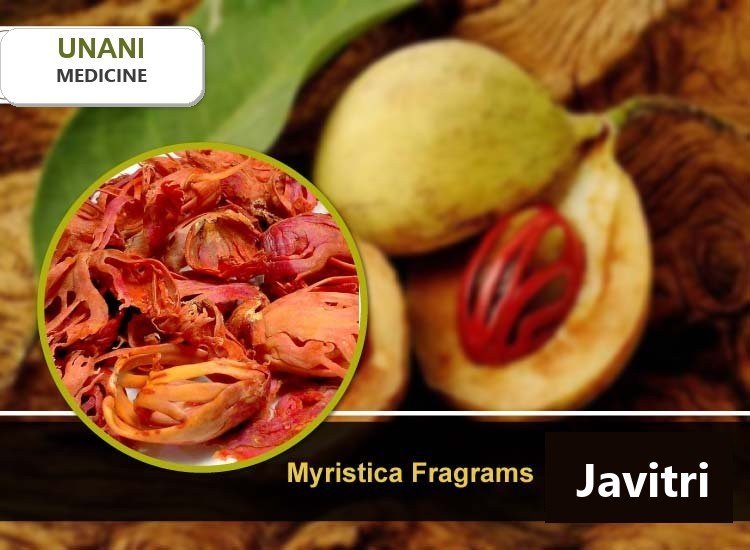
Mace (Javitri)
Javitri (Myristica fragrans) (mace) is the red lacy covering of the nutmeg seed, used in Unani medicine as a heart, stomach, liver and sexual tonic that dries excess moisture.
Other Names
Hindi: Javitri. Sanskrit: Jatipatri. Bengali: Jaitri. Marathi: Jaipatri. Gujarati: Javitri. Telugu: Jajipatri. Latin: Myristica fragrans (Mace). Persian: Javitri. Arabic: Basbasa. English: Mace.
Identification
Javitri (mace) and jaiphal (nutmeg) come from the same tree. Nutmeg trees are found in abundance on the islands of the East Indies. The reddish, thread-like covering that appears when the outer husk of the fruit splits open is called javitri. The seed of that fruit is called jaiphal. Because it is fragrant, javitri is eaten placed in paan (betel leaf).
Dosage
4 ratti to 1 gram.
Temperament (Mizaj)
Hot and dry.
Benefits (Myristica fragrans)
It is a mufarrih (exhilarant) and tonic for the stomach, liver and sexual power. Javitri has the same benefits as jaiphal, so it should be used in the same conditions as described earlier for jaiphal.
It is beneficial for relieving phlegmatic cough and for salasul bol (urinary incontinence/frequent urination). For this, give 1/2 gram of its powder with honey twice a day.
In Unani medicine, “Jawarish Basbasa (Javitri)” is made from javitri.
The tried and tested (mujarrabat) preparations of basbasa (javitri) are as follows.
Laddu Nariyal
Javitri 1 gram, jaiphal 6 grams, saffron 6 grams, ispaghol husk 12 grams, and one whole coconut. Take the coconut and make a hole in it. Put the four medicines above inside, cover the hole with a piece of coconut, seal it with a little dough, and put it into 5 kg of milk. Along with it add dates (chhuhara), chironji, walnut kernels, almond kernels and coconut kernel, 60 grams of each. When the milk has reduced to khoya, take it off and grind everything. Once fine, fry it in 2 kg of pure ghee, mix in 2 kg of ground sugar, and make laddus of 50 grams each. Eat half to one laddu daily with milk. It relieves jaryan (spermatorrhea) and sur’at (premature ejaculation) and is beneficial for male health.
Hab Sur’at
Kushta chandi (calcined silver) 12 grams, Kashmiri saffron 6 grams, javitri 1.5 grams, pure musk 1 gram, reg mahi 2.5 grams, jaiphal 25 grams, samundar sokh 25 grams, zahr mohra 3 grams. Grind everything fine and sieve it. Make pills with betel leaf juice. Give one pill with lukewarm milk before [use]. Do not use sour things.
From the Encyclopedia of Herbs by Hakeem Dr. Hari Chand Multani
Julutri, Javitri, Basbasa (Myristica fragrans)
Other Names
In Arabic it is called basbasa, in Persian bazbaz, in Sanskrit japatri, and in English mace.
Description (Mahiyat)
Javitri is the husk (aril) that wraps around the jaiphal (jauz bawwa/nutmeg) and separates from it when dry. When fresh it is greenish in colour, but on drying it turns reddish-yellow, pungent in taste and fragrant.
Habitat
The Malabar coast, the Zanzibar region, the island of Ceylon (Sri Lanka) and the Malay islands.
Uses
Because it is a mufarrih (exhilarant), it removes weakness of the heart and is included in compound heart medicines. Because it dries moisture (mujaffif-e-rutubat), it is beneficial for the lungs: it dries and absorbs their excess moisture and strengthens them. Being drying and absorbent (mujaffif and munashshif), it is a very useful medicine for salasul bol (urinary incontinence). In this condition it is applied as a paste to the back of the navel and the lower abdomen, and it is also given orally. It absorbs the excess moisture of the uterus and strengthens it, and when used with saffron as a pessary (farzaja) it cleans the uterus. Being a tonic and stimulant of sexual power, it is included in aphrodisiac confections (ma’ajeen-e-bahiya), and applied on the specific organ it produces erection. Because it is a resolvent (muhallil), opener (muftih) and carminative (kasir-e-riyah), it benefits cold (barid) diseases of the stomach. Javitri is an anti-putrefactive (dafi-e-ta’affun) and fragrant, so it is chewed to remove bad breath, and mixed with some oil it is rubbed on to remove underarm odour. Because it is a resolvent and warming (musakhkhin), it is also beneficial as a topical application for headache and migraine.
Special Benefit (Nafa Khas)
Dries moisture.
Side Effects (Muzir)
Causes headache.
Corrective (Muslih)
Gum acacia (gond babool) and rose water.
Substitute (Badal)
Jauz bawwa (nutmeg).
Dosage
One to three grams (masha).
Famous Compounds
Jawarish Zarooni Sada, Jawarish Ambari (large recipe), Hab Azraqi, Jawarish Basbasa.
Source: Taj-ul-Mufradat (research), Khawas-ul-Adwiya, by Dr. Hakeem Naseer Ahmad Tariq.
Leave a Reply